IMM #7(B) Canadian Parliament Discusses Work Permits, Health Care For Illegals

1. Mass LEGAL Immigration In Canada

Despite what many think, LEGAL immigration into Canada is actually a much larger threat than illegal aliens, given the true scale of the replacement that is happening. What was founded as a European (British) colony is becoming unrecognizable due to forced demographic changes. There are also social, economic, environmental and voting changes to consider. See this Canadian series, and the UN programs for more detail. Politicians, the media, and so-called “experts” have no interest in coming clean on this.

CLICK HERE, for UN Genocide Prevention/Punishment Convention.
CLICK HERE, for Barcelona Declaration & Kalergi Plan.
CLICK HERE, for UN Kalergi Plan (population replacement).
CLICK HERE, for UN replacement efforts since 1974.
CLICK HERE, for tracing steps of UN replacement agenda.

Note: If there are errors in calculating the totals, please speak up. Information is of no use to the public if it isn’t accurate.

2. Important Links

CLICK HERE, for 42nd Parliament on illegals entering Canada.
http://archive.is/elDlW
CLICKI HERE, for September 28, 2017 meeting evidence.
http://archive.is/uxtIR
CLICK HERE, for October 3, 2017 meeting evidence.
http://archive.is/cAsj9
CLICK HERE, for the October 5, 2017 meeting evidence.
http://archive.is/H7uM7
CLICK HERE, for the May 3, 2018 meeting evidence.
http://archive.is/GBRrl
CLICK HERE, for the May 29, 2018 meeting evidence.
http://archive.is/zIFLn
CLICK HERE, for a 2001 StatsCan longitudinal study.

3. Context For This Piece

Canadians want secure borders. They don’t want people just strolling in an staying on obviously bogus refugee/asylum claims. Understandably, they also want to know what their Parliament is doing about this issue.

And while our politicians, particularly “conservatives” repeatedly claim to be taking the issue very seriously, the records speak otherwise. So let’s take a look at what exactly has been going on.

4. Witnesses And Meetings

May 29, 2018 (Meeting 112)
Canada Border Services Agency
Jacques Cloutier, Vice-President, Operations Branch

Department of Citizenship and Immigration
Mike MacDonald, Associate Assistant Deputy Minister, Strategic and Program Policy

Department of Public Safety and Emergency Preparedness
Patrick Tanguy, Assistant Deputy Minister, Government Operations Centre, Emergency Management and Programs Branch

House of Commons
Hon. Ahmed Hussen, Minister of Immigration, Refugees and Citizenship
Hon. Ralph Goodale, Minister of Public Safety and Emergency Preparedness

Royal Canadian Mounted Police
Commr Brenda Lucki

May 3, 2018 (Meeting 108)
Canada Border Services Agency
Jacques Cloutier, Vice-President, Operations Branch

Department of Citizenship and Immigration
Louis Dumas, Director General, Domestic Network, Operations
Mike MacDonald, Associate Assistant Deputy Minister, Strategic and Program Policy

Department of Public Safety and Emergency Preparedness
Patrick Tanguy, Assistant Deputy Minister, Government Operations Centre, Emergency Management and Programs Branch

Immigration and Refugee Board
Greg Kipling, Director General, Policy, Planning and Corporate Affairs Branch
Shereen Benzvy Miller, Deputy Chairperson, Refugee Protection Division

Royal Canadian Mounted Police
Gilles Michaud, Deputy Commissioner, Federal Policing
Jamie Solesme, Superintendent, Federal Policing, Criminal Operations

October 5, 2017 (Meeting 73)
Canada Border Services Agency
Jacques Cloutier, Acting Vice-President, Operations

Department of Citizenship and Immigration
Michael MacDonald, Director General, Operations Sector
Paul MacKinnon, Assistant Deputy Minister, Strategic and Program Policy

Department of Foreign Affairs, Trade and Development
Niall Cronin, Director, North America Advocacy

Department of National Defence
BGen Lise Bourgon, Director General Operations, Strategic Joint Staff

Department of Public Safety and Emergency Preparedness
Patrick Tanguy, Assistant Deputy Minister, Government Operations Centre, Emergency Management and Programs Branch

House of Commons
Hon. Ahmed Hussen, Minister of Immigration, Refugees and Citizenship
Hon. Ralph Goodale, Minister of Public Safety and Emergency Preparedness

Royal Canadian Mounted Police
Joanne Crampton, Assistant Commissioner, Federal Policing Criminal Operations

October 3, 2017 (Meeting 72)
Department of Citizenship and Immigration
André Baril, Director, Asylum Policy
Michael MacDonald, Director General, Operations Sector
Paul MacKinnon, Assistant Deputy Minister, Strategic and Program Policy

Immigration and Refugee Board of Canada
Greg Kipling, Director General, Policy, Planning and Corporate Affairs Branch
Shereen Benzvy Miller, Deputy Chairperson, Refugee Protection Division

September 28, 2017 (Meeting 71)
Canada Border Services Agency
Jacques Cloutier, Acting Vice-President, Operations

Department of Citizenship and Immigration
Louis Dumas, Director General, Domestic Network, Operations
Michael MacDonald, Director General, Operations Sector
Paul MacKinnon, Assistant Deputy Minister, Strategic and Program Policy

Department of Public Safety and Emergency Preparedness
Patrick Tanguy, Assistant Deputy Minister, Government Operations Centre, Emergency Management and Programs Branch

Royal Canadian Mounted Police
Joanne Crampton, Assistant Commissioner, Federal Policing Criminal Operations

5. Sept 28, 2017 “Evidence”

Here are some quotes from the meeting. The topic of open work permits will be mentioned many times in these 5 meetings.

[Translation]
.
Through these measures, we are working to reduce the wait times for eligibility interviews from a few months to a few weeks, after which eligible claims are referred to the IRB.
[English]
This timely scheduling of eligibility interviews is crucial because in order to apply for an open work permit, an asylum seeker must first have their initial eligibility interview, have their claim referred to the IRB, and undergo an immigration medical examination.
.
To also help ease pressures, IRCC has begun to fast-track all work permit applications across Canada from asylum claimants with a commitment to process these within 30 days. In most cases, asylum claimants become eligible for interim federal health program, IFHP, coverage only after an officer has determined that their claim is eligible to be heard before the IRB. IFHP coverage is now available to asylum seekers who enter Canada between ports of entry in Lacolle, and are being processed on or after June 1, for those who have not yet had an eligibility interview.
.
To date, more than 5,600 persons have been issued this interim federal health program coverage under this special provision.
In closing, Chairs, IRCC, with the CBSA and all other partners in the federal family, continue to address irregular migration in accordance with Canadian and international law and in keeping with our values of an open and welcoming country.

A/Commr Joanne Crampton:
In terms of someone crossing the border between the ports of entry, the RCMP would intercept the person or persons. We then advise them that they are breaking the law under the Customs Act by crossing the border between ports of entry. The persons are then detained. Their possessions are searched to ensure there is no contraband or other illegal items. Their person is searched, because they are under arrest under the Customs Act. We then verify their identification. We do background checks and local indices checks, as well as international indices checks. If there is no noted criminality or concerns for national security and, once we have interviewed them and had a lengthy discussion as to where they came from and what their intentions are, if nothing negative comes as a result of that, we pass the individual over to Canada Border Services for further processing.

Mr. Jacques Cloutier:
At this point, for the CBSA, we receive the individual from the RCMP, as well as the information collected by the RCMP. We proceed with fingerprinting, taking of biometric information, and a cursory interview to elicit additional information. We verify identity. In those cases where we are satisfied that there are no immigration-related issues from an admissibility perspective, these individuals would be released on the terms and conditions and given an appointment to complete their eligibility interview. In cases where issues are discovered, several actions are taken immediately, including completing the interview for eligibility in its entirety, or proceeding with detention if the person is deemed to pose a risk to the public.

To be clear, the police are not detaining people illegally crossing the border for any length of time. Once identity (or who they allege to be) is determined, then they are released into Canada on a promise to appear.

Ms. Jenny Kwan:
If I may interrupt, I’ll ask if you can share this information with the committee then. Has the federal government provided any additional resources to provinces with these asylum seekers, not just for the housing component but also to support the asylum seekers as they wait for their claims to be processed?
.
Mr. Michael MacDonald:
The federal government does not provide direct support to provinces for asylum seekers awaiting their claims. The support comes at the permanent resident granting determination process, afterwards. That being said, we have taken various measures to help the provinces and to help asylum seekers by expediting across Canada all work permit applications and trying to—
.
Ms. Jenny Kwan:
If I may interrupt then, how many work permit applications have been processed and approved?
.
Mr. Michael MacDonald:
About six or seven weeks ago, we had over 6,000 work permit applications for all asylum seekers across Canada in our inventory. That is now almost eliminated, and we are processing in under 30 days any new asylum seeker’s work permit that is coming in from across Canada. We are doing those in well under 30 days. The idea is to help people get into the work force quicker.

Exactly, Very few if them will ever be forced to leave Canada. This is about putting them to work as cheap labour. Funny how the “conservatives” seem less apprehensive about illegals in this context.

Mr. Michael MacDonald:
The key to this from our perspective is allowing all asylum claimants to get their work permit faster and be able to enter the workforce if they have to.
.
At the same time, we work with community organizations as part of our regular outreach, and we do that across Canada so partnerships and getting that work permit is the key.

6. October 3, 2017 “Evidence”

After a claim is made, individuals may also apply for social assistance, which is the responsibility of provinces and territories. To help ease pressure on the social assistance budgets of provincial governments, IRCC has been fast-tracking work permit applications for all asylum claimants across Canada with a 30-day service standard.
.
In recent weeks, the government has also taken a number of steps to inform people in Canada and the United States of the facts regarding the asylum process here in Canada and to dispel false information. We are spreading the word that temporary protected status in the United States does not automatically entitle anyone to any status in our country. Some asylum claimants have believed this.

This is a bit of a review from the last meeting.

Two, many of the claimants who appear before the board are vulnerable and suffer from mental health issues, such as post-traumatic stress disorder, as a result of the trauma suffered in their homeland. So far in 2017, 93% of claimants required the assistance of an interpreter. We have the capacity to provide this service in 240 languages and dialects.
.
Three, in addition, the RPD members must be up to date on the developments of the law and must be experts on the country conditions of 126 countries so far in 2017, most of which are constantly in flux.

Wow, 93% of those coming in have such a poor grasp of English and French that they need an interpreter. Sure, we’ll be able to put them to work in no time.

It is in that context that the Refugee Protection Division developed its approach to respond to the influx of refugee claimants crossing the Quebec border. The fact that many of those refugee claimants are living in temporary tents and do not have work permits has created a number of problems, both for the refugee claimants and for the Refugee Protection Division’s processing of refugee claims.
.
First, since a large number of those refugee claimants were in a very precarious situation in Canada, fairness required that the Refugee Protection Division use all means available to process the refugee claims quickly. That means we have to prioritize the processing of as many cases as possible, to the extent that our resources permit, while meeting our overall mandate. Therefore, on August 11, we immediately created a response team, which will be active from September until the end of November.

Mr. Marwan Tabbara (Kitchener South—Hespeler, Lib.):
Thank you, Mr. Chair. Thank you to the witnesses for appearing before us today.
.
I want to talk about the work permits. You were here before to testify, Mr. MacDonald, and you discussed work permit applications as one of the measures that the government is taking to respond to the influx of asylum seekers in Quebec. I just want to read out something to you. The Canadian workers to retiree ratio today is 4:1, and by 2035 it will be 2:1.
.
Can you say that there’s a correlation, knowing that we have an aging population, with our admitting a lot of work permits, because this is great for our economy and we need this to fuel our economy? We know the numbers of our aging population and we want to fill those gaps.
.
Mr. Michael MacDonald:
I suspect there will be in a downstream effort if one were to draw that comparison. However, the most important point of the asylum seekers’ experience at this stage, their journey towards possibly being accepted and then into settlement, is to get them as established as quickly as possible to help their settlement into Canadian society. That is the real goal of the work permit for today, in the present.

Here we get some more blunt honesty. The real reason we are letting so many people in with bogus “asylum” claims is because we are looking for a replacement work force. And while the overwhelming majority of these cases are fake, certainly we will be able to accommodate these new “Canadians”.

Mr. Randeep Sarai (Surrey Centre, Lib.):
Thank you.
This question is to IRCC.
How many work permits have been issued to foreign national claimants who arrived at irregular points of entry this year?
.
Mr. Michael MacDonald:
The data I have is not quite broken down like that, but I will give you some data that is very helpful nonetheless. Prior to August 24, which was when the minister made the decision to issue work permits, we had issued 5,913 of those permits. Since August 24, we have issued 3,902. Further along, I think a very important point, which again references what I mentioned last week, is that we committed to process work permits, post-August 24, in under 30 days. Our average processing time is 13 days.
.
Mr. Randeep Sarai:
Can you describe how many or what percentage of refugee claimants are finding gainful employment? Are you tracking that? Are you able to track that with this particular cohort versus the other refugees who come through ports of entry?
.
Mr. Michael MacDonald:
No, we don’t track finding gainful employment. They’re open work permits, so people can obviously find employment and then move to other employment. The natural course of people in their settlement process is finding employment and going forward.
.
Mr. Randeep Sarai:
I can rephrase that. How many are you finding who are getting employment versus going on social assistance? That’s probably what I’m trying to get at.
.
Mr. Michael MacDonald:
Unfortunately, our department does not track that level of detail more or less at the municipal level, people finding employment in their home communities.
.
Mr. Michael MacDonald:
There are two parts to my response.
First, you are correct in your statement that the government-assisted refugee overseas selection has nothing to do with this and the work permits that are processed. We do know for the Lacolle movement that the Government of Quebec is very quickly moving to help people get their social assistance cheques while many of them are still in the interim lodging sites. If you don’t have a work permit, one would assume in the Lacolle movement you’re on social assistance and vice versa.

Serious question here: is issuing these open work permits a way of relieving the financial burden, or was this always the goal (let fake refugees in as a form of cheap labour)?

7. October 5, 2017 “Evidence”

We figured out a way to fast-track work permit applications from asylum claimants across Canada in order to alleviate the pressure on the social assistance budgets of provincial governments. This is an issue that was raised by the Government of Quebec, and we moved quickly to establish a new 30-day service standard for work permit applications so that asylum seekers may support themselves and become self-sufficient while they await the final decision on their claims. This minimizes the impact they have on provincial social assistance programs.
.
Similarly, we have built in flexibility to ensure that asylum seekers are covered under the interim federal health program immediately after background checks are completed, but while they are awaiting their initial hearing. This is important because we want to ensure that public health is protected, that asylum seekers have access to basic care, and that there is no undue burden on hospital emergency rooms and provincial health care budgets.

Sure, people who have no secure status in Canada (93% speak limited English of French), and no real means or skills will suddenly go find jobs. And who will support such precarious employees?

8. May 3, 2018 “Evidence”

Hon. Michelle Rempel:
Thank you.
Mr. MacDonald, you just mentioned that we would welcome the DACA cohort through an economic immigration stream, as they are skilled. Who is “we”?
.
Mr. Mike MacDonald:
I think Canada overall and the labour market needs within Canada is the “we” when you look at a high-skilled labour market that could be there, which would benefit the country.
.
Hon. Michelle Rempel:
Have you or has anybody in your department brought up a proposal for an economic stream regarding the DACA migration class to the minister?
.
Mr. Mike MacDonald:
I’m not aware of any analysis specifically on the DACA cohort, other than what you see in the media.

9. May 29, 2018 “Evidence”

Hon. Ahmed Hussen:
Thank you very much.
.
My visit to Nigeria was very productive. I visited the capital city of Abuja, as well as the commercial capital city of Lagos. In Abuja I met the permanent secretary of the Ministry of Interior, and on the same day I met the Minister of Foreign Affairs for Nigeria. I was able to indicate to both officials what we were facing. I made it very clear that, overall, the number of Nigerians coming regularly to Canada is actually high. There are a lot of visitors and tourists as well as international students and people who come through the express entry system, as well as the provincial nominee program.
.
In fact, the number that is coming irregularly is smaller than the regular numbers. However, it is an issue, and I emphasized to them the need for that government to co-operate closely with Canada on the issue of reiterating the message that we are always making, which is that we welcome newcomers, but we want people to come through regular migration.
.
The second request I had of the Nigerian government was that they should work closely with us to expedite the issuing of travel documents for Nigerian nationals who have exhausted the procedures and are set to be removed from Canada. On both of those requests, the Nigerian government officials I met, including the foreign minister, were clearly supportive and indicated very clearly that they will work with us on both those issues.
.
Very quickly, I also met representatives of various media outlets in Nigeria to, again, make the point that we value the contributions that Nigerian Canadians have made to our country, but that irregular migration is an issue. I also met civil society organizations who were very kind to let me know some of the challenges, some of the misinformation that was being fed to some of these officials.

So why exactly are we allowing Nigerian “refugee claimants” into Canada? They clearly aren’t in danger, so this is all a total scam.

Hon. Michelle Rempel (Calgary Nose Hill, CPC):
Thank you, Mr. Chair.
On May 23, in the Stanstead Journal, the Minister of International Development and La Francophonie was quoted as saying, “We had [a lot of] calls from local businesses last year telling us they would gladly go pick them up there and hire them,” since Canada is short on manpower and the influx of people entering illegally through Roxham Road is welcomed by a lot of people.
Do the ministers share the opinion of their colleague?
.
Hon. Ahmed Hussen:
The fact of the matter is that the issue of issuing work permits to asylum seekers was something that was brought to us through the intergovernmental task force on irregular migration. It was brought forward by the Province of Quebec. They felt that it was important for the federal government to help the Province of Quebec and other provinces expedite the issuing of work permits so that asylum seekers can support themselves as opposed to relying on provincial social services, and we’ve done that.
.
Hon. Michelle Rempel:
The sentiment the Minister of International Development expressed is that it’s a good thing that people are illegally entering the country, and that this was a way to meet Canada’s labour needs. Is that now Canada’s policy?
.
Hon. Ahmed Hussen:
The provinces have indicated their preference for asylum seekers to support themselves while they await their hearings, to work, and for us to assist them in expediting the issuing of work permits, which we have done, from three months to three weeks—

Hon. Michelle Rempel:
Just in the interest of time, I’d like a yes or no answer. Does the minister want to stop the vast influx of people illegally crossing the border at Roxham Road from the United States?
.
Hon. Ahmed Hussen:
Yes.

Rempel seems to have done a 180. Now she seems to have a problem with people entering illegally, even if they are of economic value. And how valuable can they be, if 93% of people need an interpreter when they arrived in Canada?

10. Is Cheap Labour The Real Goal?

139. Immigration by Temporary Workers The Conservative Party recognizes that temporary workers can be a valuable source of potential immigrants because of their work experience in Canada. We believe the government should:
i. continue development of pilot projects designed to address serious skills shortages in specific sectors and regions of the country, and that attract temporary workers to Canada;
ii. examine ways to facilitate the transition of foreign workers from temporary to permanent status; and

AS has been shown before, Article 139 of the CPC Policy Declaration is to create new immigration pilot programs, and, to transition TEMPORARY workers into PERMANENT residents.

11. How Many Are Really Working?

Consider this StatsCan report from 2001. Table 4 includes employment rates. Just 21% of “refugees” in the 15-24 year group were employed years later. The 25-44 group was marginally better, at 25%.

So, a lot of welfare cases, bringing their foreign cultures and often incompatible views with them. But hey, diversity is our strength.

The Case For A Moratorium On Immigration

1. Previous Solutions Offered

A response that frequently comes up is for people to ask what to do about it. Instead of just constantly pointing out what is wrong, some constructive suggestions should be offered. This section contains a list of proposals that, if implemented, would benefit society. While the details may be difficult to implement, at least they are a starting point.

2. Mass LEGAL Immigration In Canada

Despite what many think, LEGAL immigration into Canada is actually a much larger threat than illegal aliens, given the true scale of the replacement that is happening. What was founded as a European (British) colony is becoming unrecognizable due to forced demographic changes. There are also social, economic, environmental and voting changes to consider. See this Canadian series, and the UN programs for more detail. Politicians, the media, and so-called “experts” have no interest in coming clean on this.

CLICK HERE, for UN Genocide Prevention/Punishment Convention.
CLICK HERE, for Barcelona Declaration & Kalergi Plan.
CLICK HERE, for UN Kalergi Plan (population replacement).
CLICK HERE, for UN replacement efforts since 1974.
CLICK HERE, for tracing steps of UN replacement agenda.

Note: If there are errors in calculating the totals, please speak up. Information is of no use to the public if it isn’t accurate.

3. Some Context Here

It is easy to target illegal entries into the country. Without borders, and enforcement of those borders, the nation ceases to exist. Everyone should be against illegal entries, sanctuary cities, voting rights and access to social services for those in the country illegally.

That being said, the mass LEGAL immigration is actually a much larger problem.

People excluded from Canada for various reasons (such as criminality, serious criminality, organized criminality, non-compliance, terrorism or human rights violations) should stay excluded. Global News reported on a program which brought in 3,000 people since 2010 under Rule 25.1 of IRPA, but omitted another 186,000 “inadmissibles” allowed in under Rule 24(1) of IRPA from 2002 to 2017. Considering we don’t even track people leaving the country, it’s hard to say where they are.

In recent years, we have been taking in a million people LEGALLY into Canada. In 2017, for instance, we had 950,000 people enter through regular immigration channels, refugee claims, and various temporary programs. This does not include visitors or illegals.

To start off with: our governments lie about the total number of people entering annually. Categories such as student visas (students and their families), temporary foreign workers, & International Mobility Program bring in hordes of people — are not temporary. These groups generally have access to a permanent residency pathway, and other ways to stay longer. There are several pilot programs underway on top of these, including a small amnesty-for-illegals program in Toronto. Heck, we even expedite work permits for fake refugees sneaking in from the U.S.

Even if these temporary workers were to go home (and many don’t), there is the topic of remittances. According to the World Bank, hundreds of billions of dollars are sent from the West annually. How does it help our economy when money is pulled from it?

Perhaps we can replace the money lost via remittances with money from selling investor visas, regardless of how well the business does.

Bringing in large numbers of people as cheap labour results in our own citizens having to compete against foreign, often subsidized labour. It does a huge disservice to those who really need the help.

Importing students at this scale means that Canadian graduates are forced to compete against others for a limited number of jobs. This is includes professional and skilled programs. How does it benefit Canadian graduates to have their prospects cut out like that? Does the downward pressure on wages help? How does it benefit other nations when their talent leaves is a sort of brain-drain?

It doesn’t seem to matter if the “students” are really students.

Considering all the fuss about environmentalism and climate change, answer one question. How does mass immigration remove or minimize stresses to the eco-system? How does clearing new areas for farming and housing avert this climate emergency that we are supposedly in?

The overwhelming majority of immigration coming into Canada over the last several decades is of 3rd World, non-European migrants (80 to 90%). A quick glance at the top 10 “source” countries tells the same story year after year: (a) China; (b) India; (c) the Philippines; and (d) an awful lot of Muslims. Multicultis and Civic Nationalists — which are the same thing — tell us that people who have nothing in common with each other can form a cohesive society based on abstract “values”. It’s nonsense. While other groups want to retain their identity, why are Europeans considered bigots for attempting the same?

The result is predictable: enclaves forming in the major cities, such as Toronto, Montreal, Calgary, Edmonton and Vancouver. In reality, multiculturalism is a lie that never works out as planned. Balkanization is not diversity. Furthermore, it is not a lack of screening, but the deliberate efforts to forcibly remake Canada.

The breakdown of social cohesion is obvious. And anyone who has read Robert Putnam’s study will see why.

At the heart of this is the replacement agenda going on in Western nations. Canada, for example, was 96% European, according to the 1971 census. It was 72% based on the 2016 census, and still falling. Europeans will be a minority in the next decade unless something drastic happens.

This is about preserving the foundation of European nations and ones formed in that image. Replacing the population replaces the culture and the history. It doesn’t matter to me whether it is replacement by Muslims, or by high IQ, high skill Asians. I still don’t want it, and nor should others. Call it tribalism, but Westerners should be allowed to protect their identities too.

We also now have a program for survivors of domestic abuse to apply for temporary, or even permanent residence. Guess that’s what happens with importing violent cultures.

It never seems to dawn on “conservatives” that bringing in large numbers of people from left-leaning nations means political suicide. Demographic shifts will make their ideology completely unelectable. Their only concerns seem to be: (a) come legally; (b) be economically productive; and (c) don’t be a terrorist. But beyond that, conservatives have no will to preserve their people, culture, heritage, and traditions.

While the solution may seem to be to import more Europeans, they cannot be spared as THEY are being replaced in their homelands as well. Europe is being flooded with Middle Eastern and African “refugees” and migrants. We cannot help ourselves at the Europeans’ expense. Still, we must resist the replacement here.

For these reasons, and other facts and figures, I support a moratorium on immigration into Canada. With a more complete picture of the actual situation in Canada, many more people should agree.

Canadian HoC Foreign Affairs Committee Endorses UN Parliament In 1993, And Again In 2007

(Canada’s House of Commons Foreign Affairs Committee approved the idea of a UN Parliament in 1993, and again in 2007)

1. Important Links

(1) https://canucklaw.ca/un-parliamentary-assembly-proposed-a-k-a-global-government/
(2) https://en.wikipedia.org/wiki/United_Nations_Parliamentary_Assembly#cite_note-24
(3) http://archive.is/mslRy
(4) Wayback Machine, for archive of 1993, 8th Report, Standing Committee on External Affairs and International Trade, House of Commons, Parliament of Canada, Spring 1993, chaired by Hon. Jon Bosley.
(5) https://web.archive.org/web/20071229011523/http://www.worldfederalistscanada.org/0896unpa.html
(6) http://archive.is/e9IMH
(7) https://www.ourcommons.ca/Content/committee/391/faae/reports/rp3066139/391_FAAE_Rpt08_PDF/391_FAAE_Rpt08-e.pdf
(8) CLICK HERE, for “conservative” Senator Douglas Roche.

(9) https://en.unpacampaign.org/proposal/
(10) http://archive.is/GMgwO
(11) https://en.unpacampaign.org/supporters/survey/
(12) http://archive.is/KpIqW
(13) https://en.unpacampaign.org/supporters/overview/?mapcountry=CA&mapgroup=mem
(14) http://archive.is/P7ZS9

(15) https://en.unpacampaign.org/meetings/november2007/
(16) http://archive.is/NKaj8
(17) http://archive.is/kRdVJ
(18) https://en.unpacampaign.org/meetings/november2008/
(19) http://archive.is/z1jUo
(20) http://archive.is/tNX9Z
(21) https://en.unpacampaign.org/239/establishment-of-a-global-parliament-discussed-at-international-meeting-in-new-york/
(22) http://archive.is/5lMyX
(23) http://archive.is/dXbo6
(24) https://en.unpacampaign.org/265/declaration-calls-for-intergovernmental-conference-on-un-parliament/
(25) http://archive.is/dXbo6
(26) https://en.unpacampaign.org/311/post-2015-agenda-should-include-elected-un-assembly-to-strengthen-democratic-participation/
(27) http://archive.is/xloAX
(28) http://archive.is/I4Mtb

2. Context For This Article

While the story of the United Nations Parliamentary Assembly (UNPA) is still in the news, it is still a theory, at least for now.

However, Canada’s globalist politicians have been at it since well before 2007. In fact, Brian Mulroney’s Government originally approved the idea in 1993.

Why should Canadians care? Well, if you think getting fair and adequate representation from Ottawa is difficult, try getting it from a global government.

3. Timeline For UN Parliament

  • Spring 1993 – CDA HoC Foreign Affairs Comm endorses UNPA
  • July 1993 – Brian Mulroney replaced by Campbell as PM
  • October 1993 – Jean Chretien elected as PM
  • 1996 – Support in Chretien’s Gov’t for UNPA
  • 2002 – Sen. Douglas Roche endorses UNPA
  • January 2006 – Harper replaces Martin as PM
  • July 2007 – CDA HoC Foreign Affairs Comm endorses UNPA
  • August 2007 – Bernier replaces MacKay as FA Minister
  • November 2007 – First UNPA Int’l Meeting, Switzerland
  • November 2008 – Second UNPA Int’l Meeting, Belgium
  • October 2009 – Third UNPA International Meeting, USA
  • July 2010 – Trudeau endorses UNPA as an MP
  • October 2010 – Fourth UNPA Int’l Meeting, Argentina
  • October 2013 – Fifth UNPA Int’l Meeting, Belgium
  • September 2015 – Harper signs Agenda 2030
  • October 2015 – Trudeau replaces Harper as PM
  • 4. Quotes From 1993 Standing Comm Report

    The decline in Canadian support for things international – and the decline is palpable – is explained more by loss of self-confidence among Canadians than by lack of caring. There is no more important task before us than to recover some of that confidence and no more important means of doing so than through the empowerment of the United Nations. People must see that the centre can hold and that they have a role to play in making it so.

    By way of building the public and political constituency for the United Nations, the Committee recommends that Canada support the development of a United Nations Parliamentary Assembly (21) and that we offer to host the preparatory meeting of the Assembly in the Parliament Buildings as the centrepiece in our celebration of the 50th anniversary of the United Nations in 1995. We would further recommend that the Government work closely with the national organizing committee for the 50th anniversary and encourage the active participation of non-governmental organizations in the planning and holding of the Assembly.

    Conclusion
    .
    In closing this long letter the Committee wishes to commend the Government for being one of the few that has contributed energetically to keeping An Agenda for Peace alive. But alive is not good enough. Much more needs to be done. The proposals of the Secretary General should be the beginning of a vital international process of reform and renewal of the United Nations system. Canada should work hard to help make it so. The Committee intends to keep the empowerment of the UN high on its agenda and to hold additional hearings in the new session of Parliament. We would ask that the Minister respond in writing to this letter by early May.

    This is what it sounds like. The Mulroney Government, which calls itself “conservative”, has the Foreign Affairs Committee approve in principle participation in a United Nations Parliament.

    Note: Mulroney had a huge majority at that time, so there was no real need to get opposition approval on this. So no one can say he was pressured into doing it.

    5. Approval Of UNPA In 1996

    In recent years the demands on the United Nations have increased. In response, the organization has been given more autonomous powers and responsibilities. At the same time, it is necessary that the UN maintain support for its actions and decisions of the world’s citizens and governments. Creation of a UN Parliamentary Assembly is a vital first step in this process of democratizing the United Nations and ensuring its legitimacy in the eyes of world public opinion.

    The European Parliament and the Parliamentary Assembly of the Organization for Security and Cooperation in Europe (OSCE), demonstrate the important contributions that supranational parliamentary bodies can make to the work of international institutions. The history of both of these supranational parliaments also demonstrates the important, indeed essential, role in their creation to be undertaken by committed national parliamentarians.

    Under Andrº Ouellet, Canadian foreign policy was distinguished primarily by its emphasis on international trade issues. Trade promotion overshadowed some other progressive initiatives taken by Canada, notably Canada’s work at the UN on creation of an International Criminal Court, and the Canadian peacekeeping proposal (entitled Toward a Rapid Reaction Capability for the United Nations) which was presented at last Fall’s session of the UN General Assembly.

    As Foreign Affairs critic when the Liberals were in opposition, Lloyd Axworthy was a strong proponent of arms control and human rights issues and is a strong advocate of improved multilateral institutions. Many analysts expect that under Mr. Axworthy these international law and ‘world order’ issues will become a greater priority.

    In the Spring of 1993, the House of Commons Standing Committee on External Affairs and International Trade (SCEAIT) brought forward a report on Canada’s role in the United Nations. One of the Committee’s three recommendations called for Canada to support creation of a United Nations Parliamentary Assembly (UNPA), and for Canada to host the preparatory meeting of the Assembly in the Canadian Parliament Buildings. Following release of the SCEAIT Report, an ad hoc committee of parliamentarians and non-governmental representatives was established to build political support for a UNPA. Lloyd Axworthy was among a handful of Liberals who participated in the ad hoc Committee’s two meetings. Unfortunately, very little was accomplished before the 1993 general election was called and the 1993 session of the House of Commons ended.

    The New Liberal Chretien Government shares the globalist appetite and ideas that the previous Mulroney Government did. More support for creating of the actual world government.

    6. Senator Douglas Roche & UNPA, 2002

    The arguments below contain these assumptions in their essence. However, it is understood (perhaps reluctantly) that world federalism and the end of the state system is not in the mainstream political agenda for a contemporary UN. The objectives of UN reform and addressing issues of international governance are reasonable and feasible in contemporary politics. Implications for a Kantian vision of world federalism can be bruited, but at this point not much more.1 A UNPA would not be a world parliament, although some supporters and detractors of a UNPA think of it as a step towards a form of world government or global federalism.

    World government is not a necessary criterion in discussing a United Nations Parliamentary Assembly. World government is not the case here. What is at issue is governance, by which is commonly understood to be the regulation of an increasingly complex and interconnected world comprising States, societies, corporations, individuals and epistemic communities.

    The question of a UNPA, then, becomes one relating to a UNPA within the UN system and a UNPA within both the growing interconnectedness of trans-national politics and existing networks of global governance. Governance, transparency, democracy, diplomacy and international norms of behaviour – how states behave when their affairs are so intertwined – these are the issues in the background when discussing the formation of a UNPA.4 Specifically discussed below are those aspects of these phenomena that today seem to drive the argument for a UNPA.

    Some nice double speak here. Senator Roche is trying to argue that a United Nations Parliament would not actually amount to a world government. Okay.

    7. Quotes From 2007 Standing Comm Report

    CHAPTER 8 CANADA’S ROLE IN INTERNATIONAL ORGANIZATIONS AND MULTILATERAL APPROACHES TO DEMOCRATIC DEVELOPMENT
    [W]e need democracy as a basis of a safer world, we need democracy as the basis for a just system of international relations …
    Her Excellency Nino Burjandze, Speaker of the Parliament of Georgia

    The Committee has already made reference in previous chapters to Canada’s welcomed multilateralist approach to democratic development and to its valued contribution to multilateral bodies. We believe that should be continued, and enhanced where most effective, as part of the evaluation of all Canadian support for international democratic development that we have recommended.
    The Committee observes as well that international organizations are increasingly expanding their work into all areas of democratic development and governance. For example, in our meeting at the Commonwealth Secretariat, its Secretary General told the Committee that the Secretariat is trying to work both at the cultural level and with parliaments and political parties on understanding the role of the opposition and on introducing accountability measures. Mr. Christopher Child, Advisor and Head of the Democracy Section, commented that “we’d like to do much more party training.” Strengthening party systems has also become an important area of work for the International Institute for Democracy and Electoral Systems (IDEA). The role of political parties in democracy-building was the subject of the Council of Europe Forum for the Future of Democracy which took place in Moscow in October 2006 with the involvement of the Council of Europe Parliamentary Assembly to which Canada sends observers.

    The World Bank, to which Canada is an important contributor through the Department of Finance, is not allowed by its Charter to take into account the nature of the political regime, hence its role in “political development is obviously constrained,” as Sanjay Pradhan, Sector Director in the Public Sector Governance Unit told the Committee in Washington, D.C. However, within a broader conception of good governance that is linked to democratic development: “We are doing a lot in terms of accountability of the state to its citizens.” So the Bank works on things that might be considered “building blocks” of democracy. Mr. Pradhan distributed a paper “How Ongoing Operations of the World Bank Currently Strengthen Participation and Accountability,” which lists six major program areas for Bank interventions. One of these includes “parliamentary capacity development.”

    Mr. Steen Lau Jorgensen, Director of the Bank’s Sustainable Development Network, elaborated that the Bank has programs directly involving local communities in development decisions, thereby increasing the effectiveness of projects. In the Bank’s experience, more open countries do much better in achieving their development goals. The Bank therefore has an interest in building the capacity of civil society and it now even gets close to election-related processes, as in Ivory Coast where it is helping with the compiling of a national registration list. In this case, the Bank is working with the EU and the UN and through the country’s prime minister’s office. Registration is not just about elections but about establishing citizen’s eligibility for social services.

    As Mr. Jorgensen put it, there has been a “fundamental change in mindset” towards seeing poor people as citizens having rights and responsibilities. The Bank’s consequent shift away from major infrastructure projects since the late 1980s has been approved by its Board. The Bank sees this as linked to development effectiveness, which incorporates a good governance and anti-corruption agenda. For example, in the public procurement process, the Bank has established oversight through a “Procurement Watch” mechanism, and it now has a “zero tolerance” policy on corruption in World Bank-supported projects. Mention was also made of a “Global Integrity Alliance” as part of an anti-corruption strategy involving leaders in the recipient countries.

    The role of a major international financial institution like the World Bank is noteworthy in another sense, since many believe that these powerful international organizations are not themselves sufficiently democratically accountable to the publics in the countries which make up their memberships. Several of the Committee’s witnesses addressed the issue of the need to advance democratization processes from the local and national levels of governance, to the dimension of global governance. For example, John Foster of the North-South Institute referred to the Finnish-supported “Helsinki Process” which produced a 2005 Report, Governing Globalization-Globalizing Governance, that made recommendations for democratizing oversight of the global economy and strengthening the role of parliamentarians and civil society in that regard. He also made reference to the work of the Forum International de Montreal — which gets most of its funding from non-Canadian sources — and to the Spanish-based “World Forum of Civil Society Networks and its Campaign for an In-Depth Reform of the System of International Institutions…”

    The presentation to the Committee by the World Federalist Movement — Canada also devoted a lot of attention to advancing democratization at the level of international institutions, in particular in the context of United Nations reforms. Indeed it noted that this Committee in 1993 had supported the concept of a parliamentary assembly at the UN, and it went on to state:
    In April 2007, the Committee for a democratic UN (an NGO organizing network working with parliamentarians) will present publicly the “International Appeal for the Establishment of a United National Parliamentary Assembly, at press conferences around the world. Following the Appeal launch in April, an international parliamentary conference is planned for October 2007 in Geneva.

    The World Federalist representatives urged the Committee to give favourable consideration to this international appeal. We note as well that the European Parliament has supported the establishment of UN Parliamentary Assembly as part of overall UN reform, most recently in a resolution of June 9, 2005.

    In terms of working through international organizations, the biggest of all is of course the UN system. Most of the UN funding related to democratic development and governance goes through the United Nations Development Program (UNDP). Indeed, when the Committee met with the UNDP’s Pippa Norris, Director of the Democratic Governance Group, Bureau of Development Policy, and other senior staff (many of them Canadians) at the UN in New York, it was noted that this group is the largest within the UNDP.

    Ms. Norris shared with the Committee the group’s Strategic Plan, 2008-2011, and explained that its mandate in the area of democratic governance comes from various UN sources including the Millennium Declaration and a General Assembly resolution in 2000, the 2002 statement Democratic Governance Practice in UNDP, and a recent high-level panel report Delivering As One. Documents provided to the Committee included the UNDP’s Global Programme on Parliamentary Strengthening, on Support for Arab Parliaments, on Strengthening the Role of Parliaments in Reconstruction and the Prevention of Conflicts, and the annual report of its Democratic Governance Thematic Trust Fund. There was also a briefing note on CIDA-UNDP collaboration in Afghanistan. On gender issues, the Committee was told that an international knowledge network on women and politics was to be launched in February 2007, centred on an on-line tool to help education in this area. In addition, the United Nations Development Fund for Women (UNIFEM) does a lot of work on civic education for women. On electoral assistance, it was noted that collaboration between Elections Canada and UNDP goes back as far as Cambodia in 1993. However, another Canadian staff member Elissar Sarrouh (Policy Advisor, Public Administration Reform) — who formerly worked at the Parliamentary Centre — added that Elections Canada is always short of resources. So when countries express interest in having Canadian expertise, sometimes the resources are not there.

    On the UN’s work on election processes, the Committee also met with Craig Jenness (again, a Canadian), Director of the Electoral Assistance Division within the Department for Political Affairs, who explained that this takes the form both of direct electoral support, and work on electoral best practices. Rather than election observation, the UN focuses either on providing assistance to electoral offices in host countries, or on assisting with electoral operations as part of peacekeeping missions in places like the Democratic Republic of the Congo or Haiti. The budget is relatively small, with a dozen people at headquarters, although a large roster of people — including many Canadians — work around the world. Also, there is a small trust fund to allow the quick deployment of people when necessary to places like Nepal. Some 102 UN member states — and four non-member states have requested electoral assistance since 1992, and over 30 countries are now receiving or have requested such assistance — most of them in Asia, Africa and the Middle East.

    One important reason UN help is requested is that this helps legitimate the result and get it accepted — for example, in the Democratic Republic of the Congo. The UN does not work with countries unless asked by the host government or there is a Security Council mandate. The UN tries to not run elections themselves, but to assist the host government in setting up the necessary structures to do so. In post-conflict situations, a problem that often comes up is that everyone wants to win an election, but it is often difficult to convince the losers that there is a real role for oppositions. According to Mr. Jenness, “parliamentarians can help” with that since they can talk to colleagues in other countries on a peer-to-peer basis.

    Before turning to UN’s innovation of a “Democracy Fund” in 2005, and Canada’s potential role in that, it is important to recognize that notwithstanding all of this work, many questions still surround the UN’s involvement in democratic development, as well as that of international organizations such as the Community of Democracies or alternatives, which can be more explicit than the UN about their pro-democracy aims since their memberships are limited to at least nominally democratic states.

    In observing that “the UN has often been in a situation where it has been an advocate of democracy”, Jane Boulden, Canada Research Chair in International Relations and Security Studies at the Royal Military College of Canada, told the Committee:
    There are a number of member states that are not happy about the fact that the UN should play a role in advocating democracy, even when it comes to post-conflict situations where parties have agreed to democracy as part of the peace agreement.
    This relates partly to the ongoing questions about sovereignty. With the responsibility to protect, for example, there’s been an increasing acceptance that sovereignty is not sacrosanct, and for those who are resistant to these ideas, the idea that democratization or democracy is an important universal value is seen as yet another hook that western states can use as a criterion for intervention in states.

    If democracy is to be put forward as a universal value, we need to be able to make that case more effectively than we are now. That’s a factor the United Nations is grappling with, but I think it goes across the board for states as well. On this point, the questions of perceptions relate as well to the image or the perception in a number of states that the UN engages in a number of double standards. Why do we, through the United Nations, react to some conflicts and by extension then deal with some post-conflict scenarios with resources and commitment, and not others? When we feed that into the broader question about whether democracy is a western value or not, you can see how the whole package becomes an issue.

    Scepticism about UN multilateralism combined with the need to engage the United States multilaterally has led to various alternatives being suggested. For example, two prominent U.S. scholars have recently made a detailed proposal for the establishment of a 60-member “Concert of Democracies.”

    Yet to get around the fact that the UN includes many non-democracies, there has already been the creation of the Community of Democracies in 2000, with Canada as a founding member, and which met for the first time at the UN in 2004 as a UN “Democracy Caucus”. The Committee was told during our New York meetings in February 2007 that the 100-member “Caucus” is currently chaired by Mali, which is also an active member of the Group of New and Restored Democracies. His Excellency, Cheick Sidi Diarra, Ambassador and Permament Representative to the UN of Mali, was among a group of UN ambassadors and permanent representatives with whom the Committee met. We have already referred in Chapter 4 to Canada’s participation in the Community of Democracies (CD). One of our Canadian witnesses, Jeffrey Kopstein argued that, given the UN’s weaknesses and limitations, the CD should be bolstered. In Washington, where we met with Richard Rowson, President of the CD’s Council, Theodore Piccone, Director of the Democracy Coalition Project (and representative of the Club of Madrid in Washington) argued that “Canada should be a member of the [CD] Convening Group,” and that notwithstanding our multi-lateralist reputation, Canada “has been mostly at the margins in this regard.”
    Others were less convinced of the CD’s effectiveness. Richard Haas, President of the Council on Foreign Relations, told the Committee that the CD defines its democracy membership criteria too broadly and is too large to be a meaningful actor. Thomas Melia, Deputy Director of Freedom House told the Committee in Washington that the Convening Group of the CD represents in part the strategic interests of the member governments. For example, Morocco is a member although it does not meet the democracy criteria. Mr. Melia also had some cautionary words on trying for global coordination, stating that “a lot of effort can be diverted into coordination.” Instead he saw the need for “complementarity,” and “the way to pursue that is to build one’s niche.”
    Gareth Evans, President of the International Crisis Group, has also cautioned:

    Don’t pin too many hopes on Democracy Caucuses and similar grand international strategies. While in principle an attractive idea, there are simply too many institutional and interest differences between democratic countries for a united front to be sustained on anything very much, and it is not at all clear that the tentative moves to create such mechanisms have so far placed any useful pressure on non-democracies, or generated any net positive returns.

    At the same time, Mr. Evans, who remains a strong believer in a strengthened and reformed UN system, points out that individual democratic countries, notably those with great-power interests such as the U.S., are often not the best placed to promote democratic development. Even if, as several U.S. witnesses told the Committee, Canada is sometimes able to do things that the U.S. cannot, Canada cannot go it alone in this field either. Mr. Evans argues that: “One way to have an impact without such visible badging [association with Western big-power interests] is working through collaboration with multilateral coordinating mechanisms in the UN and elsewhere — the new UN Democracy Fund now getting off the ground will hopefully prove of real utility in this respect.”

    The Committee shares that hope. Indeed, there is no substitute for action by the UN, for all its faults, since it is the only truly global body. We, too, want to see it reformed and made into a more credible instrument for advancing democratic development. With respect to the UN Democracy Fund (UNDEF) set up as a result of the September 2005 UN Summit, it is supported through voluntary donations not assessed contributions. The largest donor by far is the U.S., and the second largest donor has been India, the world’s most populous democracy, with a contribution of US$10 million. That amount was matched by Japan in early March 2007, adding to UNDEF’s funding capacity of about US$ 65 million, and making it the Fund’s 28th donor country. So far Canada is not among these.

    When the Committee met with UNDEF representatives, Acting Executive Director Magdy Martinez-Soliman and Senior programme Officer Randi Davis (a Canadian) in New York in February 2007, Mr. Martinez-Soliman observed that the Fund is the first UN organization to use the word “democracy” in its title.377 Moreover, parliaments have been one of the better allies of the new fund; UNDEF staff having met with delegations from India, the United Kingdom, the European Union, the United States and others, now including Canada. The visit of the Committee was prominently noted on UNDEF’s web site (http://www.un.org/democracyfund/). It was made clear to the Committee that Canada’s involvement would be welcomed, especially as Canada’s democracy is looked upon favourably by many countries in the world.

    The idea for UNDEF was explained as a U.S. initiative proposed as part of the UN reform debate along with priorities such as human rights, management reform and a Peacebuilding Commission. (The Committee also met separately with Canadian Carolyn McAskie, UN Assistant Secretary-General in charge of the Peacebuilding Support Office.379) UNDEF currently works mostly through civil society organizations as well as partnerships with other UN organizations, including peacekeeping missions. Its first funding tranche in August 2006 involved some 70 NGOs, including in Canada the Parliamentary Centre and a journalists group in Toronto. Importantly, UNDEF funding also comes from the South; it is not in the “import-export” business in terms of democracy, and does not offer a democratic model for others to copy. Significantly, too, UNDEF does not require host government permission when it decides on funding projects. It operates with the support and legitimization of the Secretary-General and the states that make up its board, composed of the six largest contributors. UNDEF is also one of the earliest examples of the “One UN” model proposed by the report of a recent High Level UN Panel on Coherence, Delivering as One,380 that was also referred to in the Committee’s meeting at the UNDP.

    UNDEF is still a fledgling organization with only six staff (as of February 2007), and has just starting work on the ground, although it already has some 125 projects in 110 states and territories. Its regional priority is Africa (37% of project funding), followed by least developed countries outside of Africa. Project decisions are made on the basis of detailed proposals after consultation with the UN’s Department of Political Affairs and other UN organizations active in each country, following which a short list is made and presented to the board, which makes an even shorter list for presentation to the Secretary-General. With no formal advertising, UNDEF received over 1,300 applications in its first two weeks of operation — although about 700 of these did not meet its criteria. (Even when UNDEF did not fund projects, however, it has shared its database of proposals with other UN bodies, so these projects may get funding from elsewhere.)

    The UNDEF governance structure is bi-level: one composed of UN member states, and one of NGOs, respecting geographic balance, and with an advisory board that includes international democracy experts such as Guillermo O’Donnell cited by the Committee in Chapter 1. Asked why UNDEF has accepted funding from states such as Qatar that are not fully democratic, Mr. Martinez-Soliman responded that UNDEF does not judge the degree to which its donors are democratic, but poses the larger questions of: Do the citizens within a state think it is democratic, and do other states think so?

    Mr. Martinez-Soliman added that UNDEF has about 15 projects that work directly with political parties in countries such as Bolivia, Serbia and Peru. There are obviously sensitivities involved in such work. Observing that some countries have tightened their legislation on the transfer of foreign money to NGOs, in order to prevent these countries from shutting the door, UNDEF specifies that NGOs must be recognized either nationally or internationally. UNDEF also works in partnership with global and regional interparliamentary forums — for example, the Inter-Parliamentary Union (IPU), particularly on the issue of support for increasing the number of women parliamentarians, and including the Assemblée parlementaire de la francophonie.

    The Committee was told, by our Ambassador and Permanent Representative to the United Nations John McNee, that Canada’s official position on UNDEF remains one of “wait and see.” We agree that UNDEF is a work in progress. But at the same time, it is part of UN reform and a global UN effort to take democratic development seriously. Surely that goal merits Canadian support. We note as well that among UNDEF’s donors are five of Canada’s G7 partners and its Commonwealth partner, Australia. Accordingly, we believe that Canada should consider whether to become a UNDEF donor.

    Finally, there is a recurring theme that has struck the Committee during its meetings with international organizations supported by Canada that are involved in democratic development: namely, the impressive number of Canadians who are working in these organizations, often at senior levels. This is a great pool of expertise and experience upon which to draw. While some of these Canadians may be attracted back to Canada by the new Canada foundation for international democratic development that we proposed in Recommendation 12, it is also a good to have Canadians in positions of influence inside the multilateral organizations that Canada funds.

    The Committee believes that a greater effort should be made to tap into the knowledge accumulated by Canadians working in multilateral organizations. This could enrich Canada’s own approach to democratic development as it is elaborated through an enlarged Democracy Council and through the independent Canada foundation that we have proposed.

    The Foreign Affairs Committee of Stephen Harper’s Government also approved the idea of participating in a United Nations Parliamentary Assembly in July 2007. It seems that all of these successive administrations are globalists.

    8. Recommendations From 2007 Report

    Recommendation 19
    The independent evaluation of all Canadian support for democratic development that we have recommended should also assess the effectiveness of multilateral channels to which Canada provides funding. That evaluation should guide appropriate funding levels.

    Recommendation 20
    Recognizing that the future challenges of democratization processes involve governance at the level of international organizations, as well as in national and local settings, the Canada foundation for international democratic development should include these dimensions within its mandate, and should consider related proposals for support from Canadian non-governmental bodies and civil-society groups working in this area.

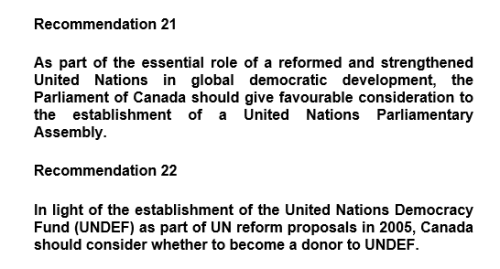
    Recommendation 21
    As part of the essential role of a reformed and strengthened United Nations in global democratic development, the Parliament of Canada should give favourable consideration to the establishment of a United Nations Parliamentary Assembly.

    Recommendation 22
    In light of the establishment of the United Nations Democracy Fund (UNDEF) as part of UN reform proposals in 2005, Canada should consider whether to become a donor to UNDEF.

    Recommendation 23
    Taking into account the expertise and experience on democratic development that has been accumulated by Canadians working in this field through multilateral organizations, Canada should make an effort to tap into this pool of knowledge in furthering its own approach to democratic development.

    Exactly what it sounds like: create and participate in a United Nations Parliament.

    9. Trudeau Endorses UN Parliament

    Our current Prime Minister endorsed the concept back in 2010. It seems doubtful that he has changed his mind since.

    Interestingly, Green Party leader Elizabeth May (who also sits on the Trudeau Foundation) has endorsed this as well.

    10. CDA Globalist Gov’ts All In Support

    Successive Canadian Governments all support being part of a UN Parliament if it ever became a reality. Canada is pretty screwed.

    Climate Propaganda In Academia — Some Big Players

    1. Important Links


    CLICK HERE, for an intro to the climate change scam.
    CLICK HERE, for Disruptive Innovation Framework.
    CLICK HERE, for humanizing transitions, energy justice.

    CLICK HERE, for Max Boykoff’s article in Scientific American.
    CLICK HERE, for Boykoff’s war on science, part I.
    CLICK HERE, for Boykoff’s war on science, part II.

    2. A Shoutout To Uppity Peasants


    It’s only fair to cite the source of these articles, as in the person who shared them. They came from a Prairie Nationalist who’s frequently busy sharpening her pitchfork. Go check out Uppity Peasants for this and other topics.

    3. Context For This Article


    The topic of climate propaganda has been covered on this site several times (see links in Section #1). However, rather than doing a complete review for each of the remaining articles, a brief commentary will be added.

    It’s downright creepy how the emotional manipulation and shameless hucksterism of climate change are treated seriously in academia. Rather than admitting there “may” be something wrong with climate research, the idea is to double down and look for alternative ways to sell the scheme.

    Still, if plunging into the messed up world of climate propaganda appeals to you, then you have two options:
    (a) Get professional help; or
    (b) Keep reading more.

    4. Heuristic Of Creative Destruction


    Moving beyond the heuristic of creative destruction: Targeting exnovation with policy mixes for energy transitions Martin David Helmholtz Centre for Environmental Research – UFZ, Germany.

    Scholars looking at policy mixes for the energy transition and seeking to facilitate a move away from fossil-based structures are increasingly addressing the opposite side of innovation. To describe this, the article introduces the concept of exnovation, referring to attempts to end fossil-based technological trajectories in a deliberate fashion. It applies a framework that encompasses innovation and exnovation alike in order to investigate the policy mix of the German energy transition. Beside finding that energy transition policy mixes need to emphasize regulatory instruments more in order to bring about decarbonization, the article also describes some general aspects of the policy mix design required to govern the innovation-exnovation nexus.

    Typically, most people want to ADVANCE their societies, but this one considers doing the opposite: leading the public down a less developed lifestyle in order to combat climate change.

    5. Bringing About Disruptive Change


    A heuristic for conceptualizing and uncovering the determinants of agency in socio-technical transitions Mert Duygana, Michael Stauffachera, Grégoire Meylanb

    There has been a growing interest in transition studies on the role of agency in bringing about disruptive change. Previous studies have examined how actors perform institutional work to create legitimacy and transform institutions. In doing so, they have provided insights into specific practices and strategies that actors follow. This paper seeks to complement existing studies by elucidating the foundations of agency that transforms institutions through institutional work. Drawing on institutional sociology and organizational studies, resources, discourses and networks of actors are identified as key elements enabling institutional work practices. The agency of each actor is conceived of as dependent on the configurations it possesses with respect to these elements. A heuristic is presented that helps to determine the configurations associated with a strong agency in empirical settings and use Swiss waste management as an illustrative case example. The heuristic enables a systematic analysis of agency across different organizational fields.

    Some research into methods and techniques for bringing about serious and disruptive changes in Western society deemed necessary for environmental protections.

    6. Disruption & System Transformation


    Disruption and low-carbon system transformation: Progress and new challenges in socio-technical transitions research and the Multi-Level Perspective Frank W. Geels

    This paper firstly assesses the usefulness of Christensen’s disruptive innovation framework for low-carbon system change, identifying three conceptual limitations with regard to the unit of analysis (products rather than systems), limited multi-dimensionality, and a simplistic (‘point source’) conception of change. Secondly, it shows that the Multi-Level Perspective (MLP) offers a more comprehensive framework on all three dimensions. Thirdly, it reviews progress in socio-technical transition research and the MLP on these three dimensions and identifies new challenges, including ‘whole system’ reconfiguration, multi-dimensional struggles, bi-directional niche-regime interactions, and an alignment conception of change. To address these challenges, transition research should further deepen and broaden its engagement with the social sciences.

    This gem takes the BUSINESS concept of disruptive innovative framework which is meant to introduce new products and technologies into the market. It then tries to apply it to the CLIMATE CHANGE industry in getting changes made.

    7. Fighting Opposing “Regime” Against Change


    Regime Resistance against Low-Carbon Transitions: Introducing Politics and Power into the Multi-Level Perspective
    Frank W Geels University of Manchester and King Abdulaziz Universit

    Abstract
    While most studies of low-carbon transitions focus on green niche-innovations, this paper shifts attention to the resistance by incumbent regime actors to fundamental change. Drawing on insights from political economy, the paper introduces politics and power into the multi-level perspective. Instrumental, discursive, material and institutional forms of power and resistance are distinguished and illustrated with examples from the UK electricity system. The paper concludes that the resistance and resilience of coal, gas and nuclear production regimes currently negates the benefits from increasing renewables deployment. It further suggests that policymakers and many transition-scholars have too high hopes that ‘green’ innovation will be sufficient to bring about low-carbon transitions. Future agendas in research and policy should therefore pay much more attention to the destabilization and decline of existing fossil fuel regimes.

    This paper views political and media types who are skeptical of the climate change industry as “resistance” and studies way around them. No real sense that they may bring up valid points. Instead, they are an obstacle to progress.

    8. Humanizing And “Energy Justice”


    Humanizing sociotechnical transitions through energy justice: An ethical framework for global transformative change
    Kirsten Jenkins, Benjamin K. Sovacoolb, Darren McCaule

    Poverty, climate change and energy security demand awareness about the interlinkages between energy systems and social justice. Amidst these challenges, energy justice has emerged to conceptualize a world where all individuals, across all areas, have safe, affordable and sustainable energy that is, essentially, socially just. Simultaneously, new social and technological solutions to energy problems continually evolve, and interest in the concept of sociotechnical transitions has grown. However, an element often missing from such transitions frameworks is explicit engagement with energy justice frameworks. Despite the development of an embryonic set of literature around these themes, an obvious research gap has emerged: can energy justice and transitions frameworks be combined? This paper argues that they can. It does so through an exploration of the multi-level perspective on sociotechnical systems and an integration of energy justice at the model’s niche, regime and landscape level. It presents the argument that it is within the overarching process of sociotechnical change that issues of energy justice emerge. Here, inattention to social justice issues can cause injustices, whereas attention to them can provide a means to examine and potential resolve them.

    The social justice nonsense which universities push is about to get a new member, so-called “energy justice”. Consider this a bastardized child of cultural Marxism and the climate change scam.

    9. Regime Destabilization, Pulp & Paper


    Explaining regime destabilisation in the pulp and paper industry
    Kersti Karltorp, Björn A. Sandén

    abstract
    .
    A transition to a carbon neutral society will require a shift from fossil to renewable resources. This will affect the conversion of biomass and related industries such as the pulp and paper industry. The purpose of this paper is two-fold: first, to describe and analyse the transformation processes in the Swedish pulp and paper industry and the adoption of biorefinery options, and second, to demonstrate how conceptualisations from strategic management can be used to describe regime destabilisation. The industry’s adoption of biorefinery options has been modest so far, but there is development along two trajectories. The first centres on gasification and the second on separation and refining. Such diverging strategies in response to external pressure can be explained by differences that exist between firms. Signs of increasing firm divergence, or ‘regime fragmentation’, might indicate the entry into a phase of regime destabilisation, and a critical point in a transition.

    Sure, let’s make the pulp and paper industry completely unprofitable and put all of those workers out on the street. Rather than finding better solutions, let’s sabotage what already exists. While it is true you can’t make an omelette without breaking a few eggs, this seems excessive.

    10. Apply Pressure To Destabilize Industries


    Sequence and alignment of external pressures in industry destabilisation: Understanding the downfall of incumbent utilities in the German energy transition (1998–2015) Gregor Kungla, Frank W. Geels

    ABSTRACT
    This article makes two contributions to the emerging research stream on regime and industry destabilisation in the transition literature. First, we replicate the multi-dimensional framework developed by Turnheim and Geels with a more contemporary study that has closer links to sustainability transitions. Drawing on a wide range of primary and secondary sources, we analyse the destabilisation of the German electricity industry, which faced multiple external pressures: renewable energy technologies, nuclear phase-out policy, the financial-economic crisis, and negative public debates. Second, we elaborate the role of multiple pressures in industry destabilisation, focusing in particular on their sequence and alignment. We inductively identify patterns such as the ‘masking effect’ of highly visible macro-shocks, ‘perfect storm’ pattern, a ‘killer blow’ effect, and spillover dynamics between external environments.

    Not sure what to add to this. If industries are considered to be environmentally unsound, let’s apply various pressures in order to destabilize and destroy them.

    11. Politically Accelerated Transitions


    Conditions for politically accelerated transitions: Historical institutionalism, the multi-level perspective, and two historical case studies in transport and agriculture Cameron Roberts, Frank W. Geels

    ABSTRACT
    This article investigates the conditions under which policymakers are likely to decisively accelerate sociotechnical transitions. We develop a conceptual framework that combines insights from historical institutionalism and the Multi-Level Perspective to better understand the political dimension in transitions, focusing particularly on the mechanisms of political defection from incumbent regime to niche-innovation. We distinguish two ideal type patterns, one where external (landscape) shocks create a ‘critical juncture’ and one where gradual feedbacks change the balance of power between niche-innovation and regime. We also identify more proximate conditions such as external pressures on policymakers (from business interests, mass publics, and technologies) and policy internal developments (changes in problem definitions and access to institutional arrangements). We apply this framework to two historical case studies in which UK policymakers deliberately accelerated transitions: the transition from rail to road transport (1920–1970); and the transition from traditional mixed agriculture to specialised wheat agriculture (1920–1970). We analyse the conditions for major policy change in each case and draw more general conclusions. We also discuss implications for contemporary low-carbon transitions, observing that while some favourable conditions are in place, they do not yet meet all the prerequisites for political acceleration.

    This is basically the same concept as before: gutting and destroying various industries. However, this one involves using political pressure in order to achieve it.

    12. Plant Based Milk?


    Rage against the regime: Niche-regime interactions in the societal embedding of plant-based milk
    Josephine Mylana, Carol Morris, Emma Beech, Frank W. Geel

    This paper engages with the debate on niche-regime interactions in sustainability transitions, using a study of plant-based milk and its struggles against the entrenched liquid dairy-milk regime, which has various sustainability problems. Plant-based milk isunder-studied, so our empirical contribution consists of an exploration of its diffusion in the UK. We make three conceptual contributions. The first calls for a bidirectional analysis that addresses niche-orientedactivities by incumbent actors, in addition to the outward-oriented activities by niche advocates presented in most studies of niche-regime interaction.The second contribution nuances Smith and Raven’s fit-and-conform and stretch-and-transform typology: using a societal embedding framework which distinguishes four environments, we suggest that hybrid patterns are possible in which innovations follow a ‘fit’ pattern in one environment but ‘stretch’ in another. The third contribution highlights th epotential role of cultural meanings in galvanizing transitions by eroding positive associations that support theregime and stabilise consumer purchasing.


    Plant based milk?
    Okay, hello unemployed dairy farmers.

    13. Destructiveness Of This Agenda

    Under the guise of “protecting the environment”, these academics conduct research in how to undermine and destabilize existing industries. There seems to be no concern for the workers and families who will be impacted if these efforts are successful.

    Of course, there are many more authors doing this sort of work, but this is a fairly accurate representation of what is going on. Ways to impose their agenda on others.

    These people are serious about it.
    They really want to bring about the end of Western society.

    Municipal Nominee Program — Expanding On Provincial NP, But Quebec Exempt

    (CBC article, QC exempt from new program)

    (Liberal pledge to create Municipal Nominee Program)

    1. Mass LEGAL Immigration In Canada

    Despite what many think, LEGAL immigration into Canada is actually a much larger threat than illegal aliens, given the true scale of the replacement that is happening. What was founded as a European (British) colony is becoming unrecognizable due to forced demographic changes. There are also social, economic, environmental and voting changes to consider. See this Canadian series, and the UN programs for more detail. Politicians, the media, and so-called “experts” have no interest in coming clean on this.

    CLICK HERE, for UN Genocide Prevention/Punishment Convention.
    CLICK HERE, for Barcelona Declaration & Kalergi Plan.
    CLICK HERE, for UN Kalergi Plan (population replacement).
    CLICK HERE, for UN replacement efforts since 1974.
    CLICK HERE, for tracing steps of UN replacement agenda.

    Note: If there are errors in calculating the totals, please speak up. Information is of no use to the public if it isn’t accurate.

    2. Important Links

    (1) https://www.cbc.ca/news/canada/montreal/municipal-nominee-program-liberals-2019-1.5309009
    (2) http://archive.is/Jhy8k
    (3) https://www2.liberal.ca/our-platform/more-help-for-communities/
    (4) http://archive.is/okGXj
    (5) https://www2.liberal.ca/our-platform/strengthened-immigration-to-grow-the-economy/
    (6) http://archive.is/sN34r
    (7) https://www2.liberal.ca/our-platform/a-more-affordable-path-to-citizenship/
    (8) http://archive.is/qrMrN

    2004.annual.immigration.report.to.parliament
    2005.annual.immigration.report.to.parliament
    2006.annual.immigration.report.to.parliament
    2007.annual.immigration.report.to.parliament
    2008.annual.immigration.report.to.parliament
    2009.annual.immigration.report.to.parliament
    2010.annual.immigration.report.to.parliament
    2011.annual.immigration.report.to.parliament
    2012.annual.immigration.report.to.parliament
    2013.annual.immigration.report.to.parliament
    2014.annual.immigration.report.to.parliament
    2015.annual.immigration.report.to.parliament
    2016.annual.immigration.report.to.parliament
    2017.annual.immigration.report.to.parliament
    2018.annual.immigration.report.to.parliament
    2019.annual.immigration.report.to.parliament

    3. Context For This Piece

    For years there have been agreements between the Federal and Provincial Governments. In essence, the Provinces write up what they think they will need for immigration, and the Feds try to accommodate that. Theoretically, these agreements act as a form of partnership which Ottawa oversees.

    And covered in other articles, there is little to no attention paid to the culture clash or demographic shift that can take place, nor of the added foreign competition that locals will face. There is little mention of wages being driven down, or of added burdens to social services. Nor much talk about the environmental impact of having to develop more housing, or expand the size of towns. Instead, the focus is always on the ECONOMIC benefits of immigration, though the connection is fuzzy at best. But hey, diversity is our strength.

    Now a new program is about to be launched which will expand on the idea: allowing not just provinces, but cities to have a say in selecting their immigration numbers. Of course, the above mentioned issues will still apply.

    And it needs to be stressed: that Quebec will be exempt from having to participate in this program. That means that the Prime Minister’s home Province won’t be experiencing the benefits of added immigration. Strange how that is.

    4. Media Coverage Of Announcement

    In Saint-Georges, there are “we’re hiring” signs everywhere — they’re stuck in storefront windows and to the sides of buildings. Morin says it is the most pressing problem facing the region.

    The Liberal Party of Canada has made a promise to help small, rural municipalities like Saint-Georges access more immigrants. But because the provincial government pledged to curb immigration, the program may never come to Quebec even if the federal Liberals are elected.
    .
    The new program would be called the “municipal nominee program.” It would mirror a similar provincial program.

    The municipal nominee problem could be a tool to help mitigate that challenge.
    The party platform doesn’t offer many details, saying only that it would create a minimum of 5,000 spaces for such a program. That’s a drop in the bucket of Canada’s overall immigration numbers. Canada is set to see more than 330,000 immigrants in 2019.

    The promise is short on details, but was a promise the Federal Liberals made. While Liberals are prone to lying, continuing to flood cities and make them unrecognizable is a promise they are likely to keep.

    And it also needs to be said, that 310,000 is not an accurate number. As addressed repeatedly here, Canada lets hundreds of thousands of “temporary” workers and students in, all of whom have a pathway to permanent residence, or to extending their stay.

    5. No Citizenship Fee

    Worth mentioning is this gem, where Trudeau promises to make citizenship applications free of charge to anyone who applies. Get ready for a deluge of applications if this promise is ever kept.

    Goldman Sachs, CCX, Obama, Climate Scam

    (Goldman Sachs Exec-VP John Rogers served in Reagan Administration)

    (Fox covered the collapse of Chicago Carbon Exchange)

    1. Founders Of Chicago Climate Exchange

    • American Electric Power (AEP),
    • Baxter International Inc.,
    • the City of Chicago,
    • DuPont,
    • Equity Office Properties Trust,
    • Ford Motor Company,International Paper,
    • Manitoba Hydro,
    • MeadWestvaco Corporation,
    • Motorola, Inc.,
    • STMicroelectronics,
    • Stora Enso North America,
    • Temple-Inland Inc,
    • Waste Management,Inc.

    Source for the CCX founders is here.

    2. Obama Was Director Of Joyce Foundation

    The CCX was set up in 2000 in anticipation of the United States joining Europe and other countries around the world to create a market that would reduce the emission of greenhouse gases. Under the system, factories, utilities and other businesses would be given an emissions target. Those that emitted less fewer regulated gases than their target could sell the “excess” to someone who was above target. Each year, the target figures would be reset lower.

    The Exchange was the brainchild of Richard Sandor, an economist and professor at Northwestern University, and it was modeled after a successful program that was launched in 1990 and helped control acid rain in the Midwest. It was initially funded by a $1.1 million grant from the Joyce Foundation of Chicago, and President Obama was a board member at the time.

    After the Democrats won the White House, the House and the Senate in 2008, businesses and investors flocked to the exchange, believing Congress would quickly approve the program. And it almost happened.

    This is a huge conflict of interest to be involved in. Barry Soetoro, (a.k.a. Barrack Obama) was a Director for an organization that helped establish the Chicago Climate Exchange. His policies (had it passed), been able to drive a great deal of consumer and tax money to the scheme.

    CCX will administer this pilot program for emission sources, farm and forest carbon sinks, offset projects and liquidity providers in North America. To foster international emissions trading, offset providers in Brazil can also participate. The development of CCX resulted from feasibility and design studies that were funded by grants from the Chicago-based Joyce Foundation and administered by Northwestern University’s Kellogg Graduate School of Management. Environmental Financial Products, LLC conducted the research and development effort.

    Source is here.

    3. Endless Connections Of Goldman Sachs

    John Rogers serves as Executive Vice President, the firm’s Chief of Staff and Secretary to the Board of Directors. He oversees Executive Administration and is responsible for the firm’s corporate affairs functions, including public, investor and government relations, as well as corporate engagement. Mr. Rogers is a member of the Management Committee, Firmwide Client and Business Standards Committee and Firmwide Reputational Risk Committee. He is also Chairman of the Goldman Sachs Foundation. Mr. Rogers joined Goldman Sachs in 1994. He was named Managing Director in 1997 and Partner in 2000.

    Previously, Mr. Rogers served as Under Secretary of State for Management at the US Department of State from 1991 to 1993. From 1988 to 1991, he was Executive Vice President of the Oliver Carr Company. Earlier, Mr. Rogers served as Assistant Secretary of the Treasury from 1985 to 1987 and as an Assistant to the President of the United States at the White House from 1981 to 1985.

    John Rogers is Executive Vice President for Goldman Sachs, and spent time in the Reagan and George Bush Sr. administrations. He is very politically connected. (Archive)

    Ms. Smith previously served on the US Treasury Department’s Commission on the Auditing Industry. She is a member of the Institute of Chartered Accountants in England and Wales.

    Another Vice President of Goldman Sachs, Sarah Smith, also is a former member of the U.S. Government. She previously served in the Treasury Department.

    Previously, Ms. Hammack was Global Head of Short Term Macro trading and global Repo trading. This included franchise market making in short dated G10 interest rate swaps, FX forwards, cross currency basis and repo. Before that, she was Co-Head of US Interest Rate Products cash trading, which included government bonds, agencies and mortgage pass-throughs. Ms. Hammack joined Goldman Sachs in 1993 as an Analyst in Capital Markets and then moved to the Interest Rate Products trading desk, where she traded a variety of instruments focused primarily on options and later agencies. She was named Managing Director in 2003 and Partner in 2010.

    Ms. Hammack is Chair of the Treasury Borrowing Advisory Committee and a member of the Treasury Market Practices Group. She also serves on the board of Math for America.

    Yet another Goldman Sachs executive who also served with the U.S. Treasury. (Archive)

    Secretary Paulson arrived at Treasury in July 2006 well prepared for the challenges he would face. He came from a 32-year career in finance with a leading global investment bank, Goldman Sachs, where he served eight years as Chairman and CEO. Paulson assembled a team of experienced professionals and reinstituted regular meetings of the President’s Working Group on Financial Markets. The coordinated efforts of the PWG’s financial regulators would later prove critical to the U.S. government’s ability to prevent the collapse of the financial system.

    Secretary Paulson’s non-partisan leadership enabled him to convince Congress to grant the unprecedented emergency powers necessary to stem the crisis. Looking to the future, Secretary Paulson and his Treasury team crafted a regulatory blueprint to fix an outdated financial regulatory structure, including reforms that ultimately became part of the Dodd/Frank financial reform legislation that would eventually be signed into law by President Obama.

    Together with President Bush, Secretary Paulson established the G20 as the premier leaders’ forum for global financial reform and economic recovery, guiding the work of the first Summit that established the roadmap for future leaders meetings.

    Yet another Goldman Sachs executive who ended up working for the Treasury Department. In fact, he was Treasury Secretary. (Archive)

    Formerly Gensler was chairman of the U.S. Commodity Futures Trading Commission, leading the Obama Administration’s reform of the $400 trillion swaps market. He also was senior advisor to US Senator Paul Sarbanes in writing the Sarbanes-Oxley Act (2002) and was Under Secretary of the Treasury for Domestic Finance, and Assistant Secretary of the Treasury during the Clinton Administration. In recognition for his service, he was awarded Treasury’s highest honor, the Alexander Hamilton Award. He is a recipient of the 2014 Frankel Fiduciary Prize.

    Gensler is currently a member of the New York Fed Fintech Advisory Group and was chairman of the Maryland Financial Consumer Protection Commission (2017-2019). He has worked on various political campaigns, most recently as CFO for Hillary Clinton’s 2016 presidential campaign, as a senior advisor to Hillary Clinton’s 2008 campaign, and subsequently as an economic advisor for the Obama 2008 campaign.

    Prior to his public service, Gensler worked at Goldman Sachs (1979-1997), having become a partner in the Mergers & Acquisition department, headed the firm’s Media Group, led fixed income & currency trading in Asia, and lastly co-headed Finance, being responsible for the firm’s worldwide Controllers and Treasury efforts.

    Gary Gensler was was chairman of the U.S. Commodity Futures Trading Commission, leading the Obama Administration’s reform of the $400 trillion swaps market. He is also now part of the New York Fintech Advisory Group.

    4. Goldman Sachs & U.S. Gov’t Connections

    John Rogers worked for the Reagan Administration.
    John Rogers worked for the George Bush Sr. Administration.
    Gensler worked for Hillary Clinton’s 2008 and 2016 presidential run.
    Henry Paulson worked for George Bush Jr.
    Henry Paulson’s work was used in Obama Administration.
    Gensler worked for the Obama Admin, Commodity Futures Trading Commission.
    Steve Bannon works for the Trump Administration.
    Sarah Smith served in the Treasury Department.
    Beth Hammack served in the Treasury Department.

    5. Australian PM, Goldman Sachs Partner

    ,center>

    Former Australian PM Malcolm Turnbull was a partner in Goldman Sachs. No surprise, he pushed an energy policy which advances a carbon tax in all but the name. No surprise since Goldman Sachs is a huge beneficiary to the climate change scam.

    6. Euro Central Bank, Goldman Sachs Executive

    Goldman Sachs Executive Mario Draghi has now been at the European Central Bank for 8 years now. It should surprise no one that the ECB supports the climate change agenda, and promotes various measures

    7. Mark Carney, BoC, BoE, Goldman Sachs

    As addressed in this previous post, Mark Carney is leaving the Bank of England for a UN position.

    On 1 December 2019, in Madrid, Spain, the Secretary-General announced the appointment of Mr. Mark Joseph Carney, OC, of Canada as his Special Envoy on Climate Action and Finance. As Special Envoy, he will focus on ambitious implementation of climate action, with special attention to significantly shifting public and private finance markets and mobilizing private finance to the levels needed to achieve the 1.5°C goal of the Paris Agreement. This will include building the frameworks for financial reporting, risk management and returns in order to bring the impacts of climate change to the mainstream of private financial decision making and to support the transition to a net zero carbon economy.

    We need unprecedented climate action on a global scale. And public and private financial systems must be transformed to provide the necessary finance to transition to low-emission and resilient systems and sectors. The Secretary-General will count on Mark Carney to galvanise climate action and transform climate finance as we build towards the 26th Conference of the Parties (COP) meeting in Glasgow in November 2020

    Mr. Carney began his career at Goldman Sachs before joining the Canadian Department of Finance and later serving as the Governor of the Bank of Canada (2008-2013). He was born in Fort Smith, Northwest Territories, Canada in 1965. He received a bachelor’s degree in Economics from Harvard University in 1988. He went on to receive a master’s degree in Economics in 1993 and a doctorate in Economics in 1995, both from Oxford University.

    Carney’s announcement sounds impressive, but let’s be clear: this is about wide scale wealth transfer. The claims about environmentalism and saving the planet are just pretexts for doing so.

    It’s interesting to tap a former banker (heads of both Bank of Canada and Bank of England). Does he plan to use this “climate finance” agenda the same way that central banks control national finances?

    Climate modelling over any length of time has never worked. Why? Because models are just guess, predictions. They aren’t proof of anything. And despite claims to the contrary, the people doing the estimating know so little about the environment that such precise predictions aren’t realistic. Also, scientific research is frequently politically driven.

    See the official announcement, and the COP25 announcement in Madrid, Spain. Carney is to become the UN Envoy on Climate Finance Action.

    A charitable take might be that Carney will lobby for more Carbon taxes to fund this scheme. A less charitable view might be that Carney will use his considerable power and influence to force nations to pay up.

    And in keeping with the theme so far, Mark Carney was a Director at Goldman Sachs prior to working at the Bank of Canada, Bank of England, and now the UN.

    8. Goldman Sachs, Chicago, CCX, White House Conspiracy

    An interesting blogpost by Bob Beauprez ties a lot of it together, and connects the major players in this climate change scam. Please read the actual posting. (Archive)

    By Bob Beauprez
    When it was announced that the leaders of Goldman Sachs would be sitting in front of Congress, getting grilled over the financial crisis, most people knew it was nothing more than an opportunity for politicians to grandstand while beating down a straw man.
    But this? A corruption scandal that is bigger than any other in the history of the United States. It could explain the “why” behind the “Climategate” scandal that broke last year but was ignored by the American mainstream media. Not only are several former Goldman Sachs executives working inside the Obama administration, but the banking giant has a 10% stake in cap and trade technology via the Chicago Climate Exchange, an entity that Barack Obama helped form as a Board member of the Joyce Foundation.

    Political commentator and former Colorado Congressman, Bob Beauprez (R), has gotten an insider’s look at political theater, but when the congressional hearings that took place with Goldman Sachs executives is viewed through the lens of this kind of conspiracy, it sheds a whole new light on what is really going on behind the curtain.

    Glenn Beck broke the story on his April 26th television show and regardless of how you view Beck, the odds of all these connections between all of these entities, tying each back to a $15 Trillion scam are far too long to be strictly a coincidence.
    Here are the players and their roles:

    Joyce Foundation – A group founded in 1948 that took a sharp turn to the left after it’s founder, Beatrice Joyce Kean died in 1972.
    Barack Obama – President of the United States and one time Board member of the Joyce Foundation. Largely responsible for creating the Chicago Climate Exchange by funneling money to it from the Joyce Foundation.
    Chicago Climate Exchange (CCX) – An exchange dealing exclusively with Cap and Trade passes, techonology, etc. It was formed largely due to Obama’s role as Board member on Joyce Foundation. Obama oversaw the funneling of money from that foundation to the CCX as well as to an entity headed by Bill Ayers’ brother.
    Valerie Jarrett – Senior advisor to Barack Obama and current Board member on the Joyce Foundation.
    Al Gore – Founder of London-based Generation Investment Management (GIM). London also happens to be in the same country where climategate broke. GIM owns 10% of the CCX.
    Goldman Sachs – Banking giant that, like Gore, owns 10% of the CCX. Also worthy of note is that at least six former Goldman Sachs executives work inside the Obama administration while Congress puts on a dog and pony show, publicly chastising other Goldman execs about their supposed complicity in the financial crisis.
    Franklin Raines – Former head of Fannie Mae. While there, Raines used taxpayer dollars from Fannie Mae to purchase cap and trade technology.

    9. More On: Goldman, Chicago, CCX, White House

    Another blogpost, called what really happened, further details the collusion and corruption between the Obama Administration, the City of Chicago, the Chicago Climate Exchange, Goldman Sachs, and the Clintons. Please check that out as well.

    The connections between these parties are too great to ignore. The entire climate change industry is a scam, where environmentalism is used as a sales pitch.

    So far so good; now the INTERESTING parts.
    One ShoreBank co-founder, named Jan Piercy, was a Wellesley College roommate of Hillary Clinton. Hillary and Bill Clinton have long supported the bank and are small investors.

    Another co-founder of Shorebank, named Mary Houghton, was a friend of Obama’s late mother. Obama’s mother worked on foreign MICRO-LOANS for the Ford Foundation. She worked for the foundation with a guy called Geithner. Yes, you guessed it. This man was the father of Tim Geithner, our present Treasury Secretary, who failed to pay all his taxes for two years.

    Another founder of ShoreBank was Ronald Grzywinski, a cohort and close friend of Jimmy Carter.

    The former ShoreBank Vice Chairman was a man called Bob Nash. He was the deputy campaign manager of Hillary Clinton’s presidential bid. He also sat on the board of the Chicago Law School with Obama and Bill Ayers, the former terrorist. Nash was also a member of Obama’s White House transition team.

    (To jog your memories, Bill Ayers is a Professor at the University of Illinois at Chicago. He founded the Weather Underground, a radical revolutionary group that bombed buildings in the 60s and 70s. He had no remorse for those who were killed, escaped jail on a technicality, and is still an admitted Marxist).

    When Obama sat on the board of the JOYCE FOUNDATION, he “funneled” thousands of charity dollars to a guy named John Ayers, who runs a dubious education fund. Yes, you guessed it. The brother of Bill Ayers, the terrorist.

    Howard Stanback is a board member of Shorebank. He is a former board chairman of the Woods Foundation. Obama and Bill Ayers, the terrorist, also sat on the board of the Woods Foundation. Stanback was formerly employed by New Kenwood Inc., a real estate development company co-owned by Tony Rezko.

    (You will remember that Tony Rezko was the guy who gave Obama an amazing sweet deal on his new house. Years prior to this, the law firm of Davis, Miner, Barnhill & Galland had represented Rezko’s company and helped him get more than 43 million dollars in government funding.Guess who worked as a lawyer at the firm at the time. Yes, Barack Obama).

    Adele Simmons, the Director of ShoreBank, is a close friend of Valerie Jarrett, a White House senior advisor to Obama. Simmons and Jarrett also sit on the board of a dubious Chicago Civic Organization.

    Van Jones sits on the board of ShoreBank and is one the marketing directors for “green” projects. He also holds a senior advisor position for black studies at Princeton University. You will remember that Mr. Van Jones was appointed by Obama in 2009 to be a Special Advisor for Green Jobs at the White House. He was forced to resign over past political activities, including the fact that he is a Marxist.

    Al Gore was one of the smaller partners to originally help fund the CHICAGO CLIMATE EXCHANGE. He also founded a company called Generation Investment Management (GIM) and registered it in London, England. GIM has close links to the UK-based Climate Exchange PLC, a holding company listed on the London Stock Exchange. This company trades Carbon Credits in Europe (just like CXX will do here) and its floor is run by Goldman Sachs. Along with Gore, the other co-founder of GIM is Hank Paulson, the former US Treasury Secretary and former CEO of Goldman Sachs. His wife, Wendy, graduated from and is presently a Trustee of Wellesley College. Yes, the same college that Hillary Clinton and Jan Piercy, a co-founder of Shorebank attended. (They are all friends).

    This blog, as with the last one, I do not claim to own. You should go check out the sites on your own for further information.

    10. It’s All A Scam

    Despite the media and political hype, this is a scam, and has been since day one. There is a collusion between corrupt parties who are ripping off the public based entirely on lies. Who are they? Well, the above 2 sections outline it pretty well.

    Taxing the public and funnelling that money was never meant to prevent global warming, or climate change, or help the environment in any way. It was always a scam to fleece the public under the pretense of doing good.

    Do your research.
    Connect the dots.

    (1) https://www.investopedia.com/news/26-goldman-sachs-alumni-who-run-world-gs
    (2) http://archive.is/bTmOy
    (3) https://www.goldmansachs.com/our-firm/leadership/executive-officers/john-f-w-rogers.html
    (4) http://archive.is/wMH3n
    (5) https://www.goldmansachs.com/our-firm/leadership/executive-officers/sarah-e-smith.html
    (6) http://archive.is/kvX3d
    (7) https://www.goldmansachs.com/our-firm/leadership/executive-officers/beth-hammack.html
    (8) http://archive.is/8QGbL
    (9) https://www.treasury.gov/about/history/Pages/hmpaulson.aspx
    (10) http://archive.is/FN28
    (11) https://www.foxnews.com/politics/collapse-of-chicago-climate-exchange-means-a-strategy-shift-on-global-warming-curbs
    (12) http://archive.is/bpFDW
    (13) https://www.news.com.au/national/politics/labor-might-support-malcolm-turnbulls-national-energy-guarantee/news-story/fb533cf699f5d4f2f69668db618232d8
    (14) http://archive.is/4CeSp
    (15) https://www.cnbc.com/2019/10/24/mario-draghi-key-moments-at-the-european-central-bank.html
    (16) http://archive.is/ozhTd
    (17) https://www.ecb.europa.eu/ecb/orga/climate/html/index.en.html
    (18) http://archive.is/rYewy
    (19) https://fortune.com/2016/08/17/donald-trump-bannon-mnuchin-goldman/
    (20) http://www.whatreallyhappened.com/WRHARTICLES/shorebank.php
    (21) http://archive.is/F06YB
    (22) http://www.freerepublic.com/focus/chat/2086494/posts
    (23) http://archive.is/S8y33
    (24) https://www.abeldanger.org/as-director-of-joyce-foundation-obama/
    (25) http://archive.is/LFCT3
    (26) https://fortune.com/2016/08/17/donald-trump-bannon-mnuchin-goldman/
    (27) https://mitsloan.mit.edu/faculty/directory/gary-gensler
    (28) http://www.unitypublishing.com/Government/Maurice%20Strong.htm
    (29) http://archive.is/n88c7
    (30) http://www.thecypresstimes.com/conspiracy-reality-connections-between-white-house-chicago-climate-exchange-and-goldman-sachs-too-big-to-ignore
    (31) http://archive.is/6ZASr