

In 2018, the CPC MP for Durham, Erin O’Toole, introduced C-405, a Private Member’s Bill to make changes regarding employee pension plans. While touted as some great overhaul for workers, things are not what they appear to be.
Bill C-405 Introduced In June 2018
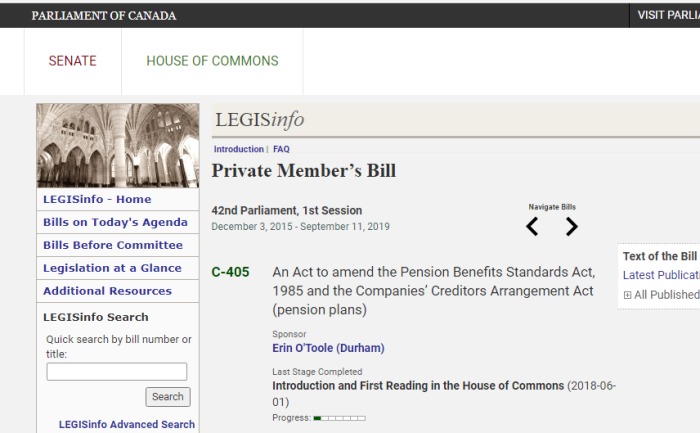
Bill for Private Members rarely get far in the House of Commons, let alone pass. Often, they are just a way to signal to the sponsor that efforts are being made. O’Toole’s Bill didn’t get anywhere in Parliament, but it’s unclear how serious he was about pushing it.
Pension Benefits Standards Act

Termination and Winding-up of Pension Plans
Marginal note:Deemed termination
.
29 (1) The revocation of registration of a pension plan shall be deemed to constitute termination of the plan.
Effect of termination on assets
.
(8) On the termination of the whole of a pension plan, all assets of the plan that are to be used for the purpose of providing pension benefits or other benefits continue to be subject to this Act.
The language of section 29(8) of the Pension Benefits Standards Act is quite clear. Once a pension plan is terminated, the funds must be dispersed to those who have contributed to the plan. Here is part of what O’Toole wanted to add.
Amendment — liquidation, assignment or bankruptcy of the employer
(8.1) If an employer is the subject of proceedings under the Companies’ Creditors Arrangement Act or Part III of the Bankruptcy and Insolvency Act and the amount required to permit a pension plan to satisfy all obligations with respect to pension benefits and other benefits to be provided under the plan is greater than the assets of the plan, the administrator may
.
(a) despite subsection 10.1(2) and the terms of the plan, amend the plan to change the nature or form of the pension benefits and other benefits to be provided under the plan; or
.
(b) apply to the Superintendent for permission to transfer or permit the transfer of any part of the assets or liabilities of the pension plan to another pension plan.
Consent to amendment
.
(8.2) Before a pension plan may be amended or part of its assets or liabilities transferred in accordance with subsection (8.1),
.
(a) the administrator must provide any prescribed information, in the prescribed manner, to the members or former members, to any other persons entitled to pension benefits and to the representatives of the members or former members and of any other persons entitled to pension benefits; and
.
(b) the amendment or transfer must be approved by more than one third of the members or former members and of any other persons entitled to pension benefits or by the representatives of more than one third of the members or former members and of any other persons entitled to pension benefits.
.
No action against administrator
(8.3) No action lies against any administrator for amending a plan or for transferring or permitting the transfer of any part of the assets or liabilities of a pension plan to another pension plan in compliance with subsections (8.1) and (8.2).
Bill C-405 would have allowed employers to transfer the pension funds rather than pay out if the company were in serious financial difficulties.
As for the consent, that is an extremely low threshold. Forget a super majority, or even a simple majority. Only 1/3 would have to approve for this to happen. Even worse, the “representatives”, or people claiming to represent the workers could simply approve on their behalf. This seems ripe for abuse.
While transferring pension funds to another company may make that more solvent, the reality is, those employees did not sign up for it initially. An argument can be made that they should simply be allowed to collect on their entitlements, and walk away. If an opt-out were provided so individual members could cash out, it would nullify a lot of the criticism.
Companies’ Creditors Arrangement Act
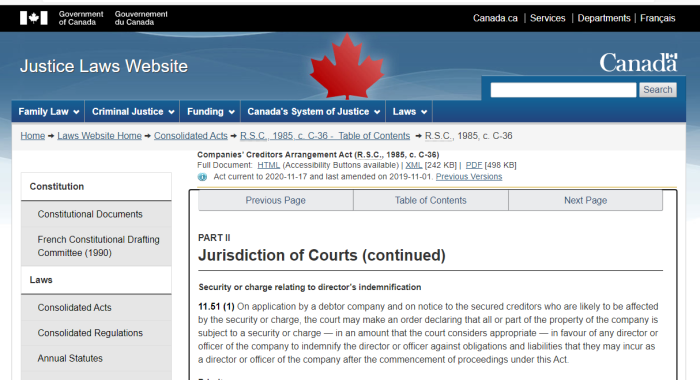
Companies’ Creditors Arrangement Act
.
3 The Companies’ Creditors Arrangement Act is amended by adding the following after section 11.52:
.
Limitation — pension plans
11.53 No order may be made under this Part respecting the approval of a plan offering incentives to certain directors, officers or employees to remain in the employ of the debtor company for the period during which the company is expected to be subject to proceedings under this Act unless the court is satisfied
.
(a) if the debtor company participates in a prescribed pension plan for the benefit of its employees, that the relevant parties have entered into an agreement, approved by the relevant pension regulator, respecting the payment of the amounts referred to in subparagraphs 6(6)(a)(ii) and (iii);
.
(b) that the directors, officers or employees are necessary for the successful restructuring or liquidation of the debtor company or for the protection and the maximization of the value of the company’s property;
.
(c) that the directors, officers or employees have received a job offer from another person than the debtor company and the offering of the incentives is necessary for their retention in the employ of the debtor company; and
.
(d) that the amount of the incentive offer
.
(i) is not greater than ten times the amount of a similar incentive offer given to an employee of the debtor company for any purpose during the previous calendar year; or
.
(ii) if no incentive referred to in subparagraph (i) was offered, is not greater than an amount equal to 25% of the amount of any similar incentive given to a director or officer of the debtor company for any purpose during the previous calendar year.
Incentives and bonuses (primarily aimed at officers and directors), would still be allowed to be offered, and not be vulnerable to a court order. However, those incentives would be capped. Seems strange that heads of failing companies should be offered any type of incentives.
Does This Bill Benefit Workers?
If a company is failing, and going under, the right thing to do is to pay out its pension holdings to the people who have contributed to it. Transferring elsewhere, especially with such a low threshold, seems like shifting the goal posts. At a minimum, those who have contributed should be able to just take a pay out and leave.
People who run failing companies shouldn’t be getting bonuses, even if they are capped. This just rewards incompetence, often at the cost of other assets of the company.
The legislation was promoted as a way to protect pensions and to keep them going. However, such transfers (possible with just a minority of support), potentially remove all control from workers. And as with everything, the devil is in the details.
For now, it appears to be dead.
Private Member’s Bill C-405 Introduced By Erin O’Toole
Text Of Bill C-405 (First Reading)
Pension Benefits Standards Act, 1985
Companies’ Creditors Arrangement Act
Open Parliament: Announcement From Erin O’Toole
Open Parliament: Debate On Bill C-405