
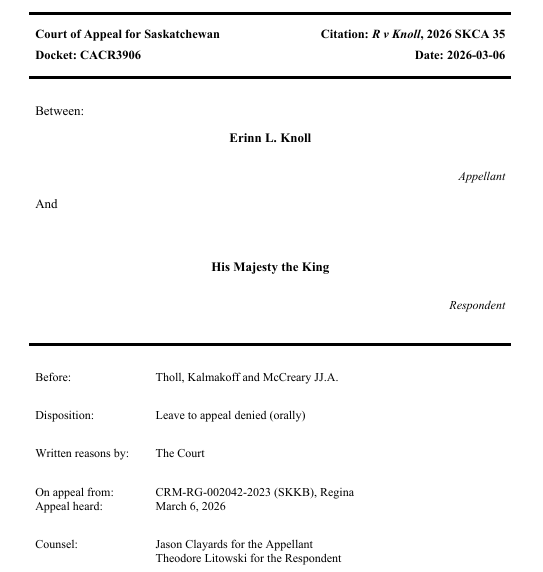
Last week, the Saskatchewan Court of Appeal refused to grant leave (permission) to appeal a decision from a few years ago. Like many, Erinn Knoll had been criminally charged for exercising her rights to protest. She was ultimately acquitted by the Provincial Court, although not everyone was.
Typically, when a Defendant brings an Appeal, it’s to challenge their: (a) conviction; (b) sentence; or (c) both. However, she did something quite different. She challenged an interlocutory (or intermediate) ruling that denied relief based on the Bill of Rights.
Even though she was cleared, Knoll still wanted vindication that what she was doing was protected expression.
The attitude of the Court appeared to be one of confusion of disbelief. As she was ultimately acquitted, why bother appealing an earlier ruling? From the decision:
[2] Notwithstanding her acquittal, Ms. Knoll appealed to the Court of King’s Bench, seeking to reverse mid-trial rulings that had dismissed her applications challenging the constitutionality of the Public Health Order, and her application for a stay of proceedings based on an alleged violation of her rights under s. 11(d) of the Charter (see: R v Hagel et al (18 January 2023), Regina Information #991192882 (SKPC); R v Friesen, 2023 SKPC 18; and R v Knoll, 2023 SKPC 29).
[3] A judge of the Court of King’s Bench, sitting as a summary conviction appeal court, dismissed Ms. Knoll’s appeal because she determined that there was no jurisdiction to hear an appeal from an interlocutory ruling in those circumstances (R v Knoll (24 March 2025), Regina CRM-RG-00242-2023 (SKKB)). Ms. Knoll now seeks leave to appeal, and to appeal, against the ruling of the summary conviction appeal court.
[6] A right of appeal exists only where a relevant statute provides for it. In this case, the applicable provision of the Criminal Code – s. 813(a) – grants defendants in summary conviction proceedings the right to appeal against only: (i) a conviction or order made against them; (ii) a sentence imposed on them; or (iii) a verdict or finding made under the mental disorder provisions of the Criminal Code. In this context, the word “order” means an order that finally disposes of the charge set out in the information. There is nothing in s. 813(a), or anywhere else in the Criminal Code, that gives a person who has been acquitted the right to appeal against an unfavourable interlocutory ruling made during the trial.
[8] All of this means that Ms. Knoll’s proposed appeal not only lacks merit, but also that it is not significant to the administration of justice generally because the question it raises is one that has been definitively answered.
[9] Additionally, the fact that Ms. Knoll was acquitted of the charge means that she is not facing a deprivation of liberty, and there is no risk of an injustice going unaddressed if leave to appeal is not granted.
Predictably, the Crown also argued that the case was moot. Had there been a conviction, then it would possibly be grounds to appeal, but not here.
While Knoll did win in the criminal case, she wanted a Court to admit she was right. But that didn’t happen, and Justices Tholl, Kalmakoff and McCreary had little interest in what they called “academic”. Never mind that such a ruling might help if such actions were repeated in the future.
***Note: The Appellant’s papers were prepared by Chris Weisdorf. In Ontario, he argued and won a Bill of Rights Appeal in the Summer of 2024. Those papers are an interesting read.
KNOLL COURT DOCUMENTS:
(1) https://www.canlii.org/en/sk/skpc/doc/2023/2023skpc29/2023skpc29.html
(2) Court Of Appeal: 2026 SKCA 035
(3) R. v. Knoll – Appellant – Memorandum of Argument – Final – 2025-01-28
(4) R v Knoll – Appeal Book – Appellant – Knoll – 23-MAY-2025
(5) R v Knoll – Factum – Appellant – Knoll – 23-MAY-2025
(6) R v Knoll – Written Submission on Repo Decision – Appellant – Knoll – 13-FEB-2026
(7) CRM-RG-000242-2023 – AGSK Brief
FERNANDO COURT DOCUMENTS:
(1) https://www.canlii.org/en/on/oncj/doc/2024/2024oncj336/2024oncj336.html
(2) R. v. Fernando_Ruling_Transcript_26_June_2024
(3) R. v. Fernando – Notice of Appeal – Signed – 2023-09-14
(4) R. v. Fernando – Appellant – Appeal Book – 2024-01-19
(5) R. v. Fernando – Factum of the Appellant – 2024-02-29
(6) R. v. Fernando – Reply Factum of the Appellant – 2024-06-21
Discover more from Canuck Law
Subscribe to get the latest posts sent to your email.
Ronnie, you weren’t present that day in Edmonton (March 12th, 2024) when our (PFF/PHTL) case was dismissed by Cathy Coughlan because it was apparently a labour-union matter (I was a middle management exec reporting to Doug Ettinger – Cathy was incompetent and lazy – I know incompetence and laziness when I see it cause I had to witness it every day of my 15 years working in that toxic hole). We were told we were engaging the wrong court. She advised we take it back to the employer (Canada Post), allowing the Federal Government – Cathy’s employer, to slip off the hook.
Something happened at or about 11:00 am of the second day of proceedings, between our lawyer (their lawyer) Leighton Grey, the counsel for the Government and Canada Post, and Coughlan, that essentially ended the case – dismissed – thrown out of court after the defence (Feds and CPC) had a full day in court to present their case before the judge ever heard a peep from us – the plaintiff. That was weird, but not if your boss is on trial and you are not accountable.
As her worship was headed to her office (behind the pulpit?), someone in the gallery yelled out “We are not livestock!” The look on Coughlan’s face was all revealing …. sociopaths do not like having a mirror held up to their faces (remember Dorian Grey and his painting?)
Our judiciary is captured just like medicine and science here in Canada. Scientism is a bizzaro distortion of Science. In Scientism, you can make it up as you go … black is white and up is down, but the “evidence” is couched in scientific terminology and paraphernalia like the white lab coat – a clown in a white lab coat, to fool people into believing that what they are hearing or seeing is science. Couldn’t be further from the truth, when put against principles, axioms and laws of science but the average person doesn’t have that background (like I do).
I would argue that the judicial system in Canada has spiralled down into a similar sewer. The law works for the government, not the people – like it did. When it comes to the last six years, in particular, the judiciary has performed exactly like a troop of trained seals, slapping their flippers as the government/corporations toss them a mackeral or two for being obedient servants.
The thought of accepting responsibility for their incompetence – real or acted (after all everyone wants to eat … even district court judges, apparently) – or cruelty in sitting up there on that throne, is obscene and Ms. Knoll had her nose rubbed in it because these people have all the authority to act as they and no accountability or responsibility to us any longer. But it’s all been done before, right?
https://encyclopedia.ushmm.org/content/en/article/law-and-justice-in-the-third-reich
To think otherwise, in light of the evidence (one’s own senses) would be to wallow in denial just as Germany did in 1933 – 1945. We’re in a lot of trouble and so far no one is showing up to get us out of the pit and shovels like Cathy Coughlan won’t help.
OF COURSE THEY WONT
They did not refuse the bill of rights – an appeal was brought that could not be heard by the appeal courst
[6] A right of appeal exists only where a relevant statute provides for it. In this case, the applicable provision of the Criminal Code – s. 813(a) – grants defendants in summary conviction proceedings the right to appeal against only: (i) a conviction or order made against them; (ii) a sentence imposed on them; or (iii) a verdict or finding made under the mental disorder provisions of the Criminal Code. In this context, the word “order” means an order that finally disposes of the charge set out in the information. There is nothing in s. 813(a), or anywhere else in the Criminal Code, that gives a person who has been acquitted the right to appeal against an unfavourable interlocutory ruling made during the trial.
MEANING
Section 813(a) of the Criminal Code sets out the appeal rights for defendants in summary conviction matters.
Under that section, a defendant can appeal only three things:
A conviction or order made against them
A sentence imposed on them
A verdict or finding related to mental disorder provisions
They appealed her rights were violated – DAAAAA
If the accused is acquitted, they cannot appeal earlier rulings that went against them during the trial because the case has already ended in their favour.
And you cannot appeal something if the Criminal Code does not explicitly give you that right